By Shilpa Khirbat | Medical Writer & Health Blogger | is burnout a medical diagnosis
Part of the Mind-Body Series at The Health Explainer. Catch up here: [Part 1 — Why Mental Stress Makes You Physically Sick] | [Part 2 — Your Gut Has Its Own Brain] | [Part 3 — What Happens to Your Brain During a Panic Attack] | [Part 4 — How Chronic Inflammation Connects Body and Mind]
Everyone seems to be burnt out these days.
The word is everywhere from conversations about work, on social media to the headlines about the mental health crisis. People use it to describe exhaustion after a hard week, disillusionment with a job they once loved, or a bone-deep fatigue that sleep alone doesn’t seem to fix.
“One important question to consider is whether burnout qualifies as a medical diagnosis.”? Or is it a cultural concept — a useful shorthand for a collection of feelings that medicine has not quite figured out what to do with?
The answer, as with most things in health science, is more nuanced than either a simple yes or no. “It matters greatly, since recognition of burnout as a clinical condition shapes whether it is acknowledged, addressed, and whether sufferers gain access to the care they need.” Here is what science and the official classification say:
What Burnout Actually Is — The Official Definition
In 2019, the World Health Organization (WHO) made a significant move. In the eleventh revision of the International Classification of Diseases (ICD-11), burnout was included — but with a precise and important clarification that most media coverage missed entirely.
The WHO defines burnout as an occupational phenomenon, not a medical condition. 1
The distinction is deliberate and meaningful. Burnout is classified under “Factors influencing health status or contact with health services” — the same category that includes things like relationship stress and housing problems. It is something that influences health, not a disease or disorder.
According to the ICD-11, burnout is characterized by three dimensions, all specifically resulting from chronic workplace stress that has not been successfully managed:
- Feelings of energy depletion or exhaustion
- Increased mental distance from one’s job, or feelings of negativism or cynicism related to one’s job
- Reduced professional efficacy
Two things about this definition are worth highlighting. First, all three dimensions must be present — exhaustion alone is not burnout by the WHO definition. Second, and crucially, the WHO specifies that burnout refers specifically to the occupational context. It should not be applied to experiences in other areas of life.
Burnout vs Depression: A Critical Distinction
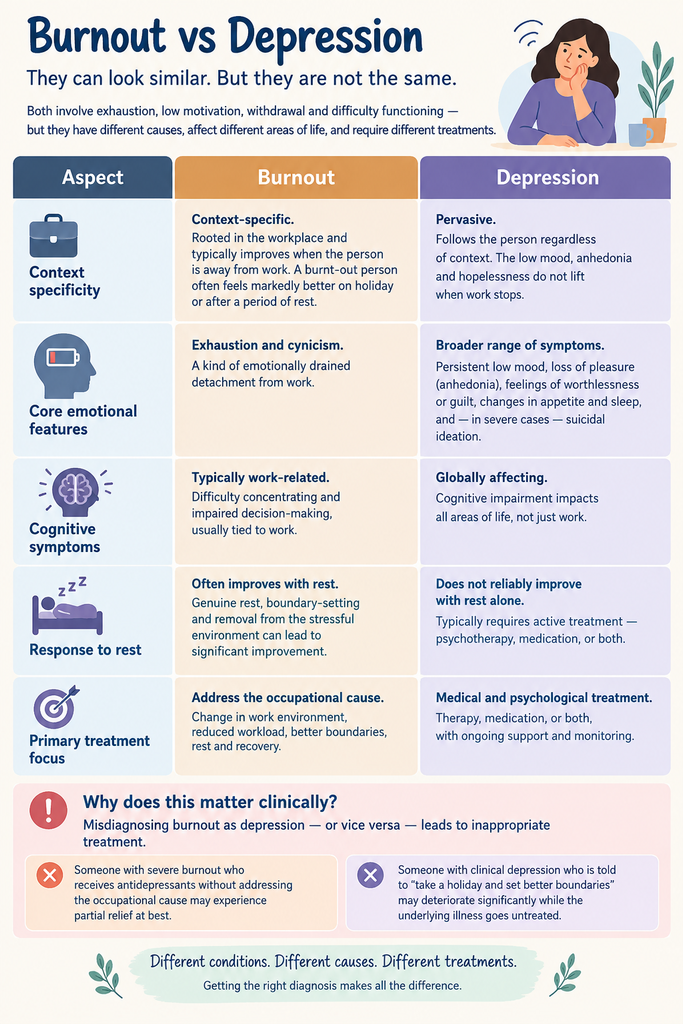
The single most important clinical distinction in this entire conversation is the one between burnout and depression — and it is routinely blurred in popular discussion.
This blurring has real consequences. While burnout and depression overlap in symptoms, they differ in what triggers them and in how professionals treat them.2,3
Here is how they differ:
Context specificity. Burnout is context-specific — it is rooted in the workplace and typically improves when the person is away from work. A person suffering from burnout often feels recharged after a vacation or a period of rest. Depression, by contrast, is pervasive, it follows the person regardless of context. The low mood, anhedonia, and hopelessness of depression do not lift when work stops.3
Core emotional features. Burnout is characterized primarily by exhaustion and cynicism, a kind of emotionally drained detachment from work. Depression involves a broader constellation of symptoms, including persistent low mood, loss of pleasure in things previously enjoyed (anhedonia), feelings of worthlessness or guilt, changes in appetite and sleep, and in severe cases suicidal ideation.
Cognitive symptoms. Both conditions can involve difficulty concentrating and impaired decision-making. In burnout, these are typically work-related. In depression, cognitive impairment is globally affecting all areas of life.
Response to rest. Rest and boundaries can help burnout, but depression often requires therapy or medication to improve.
Why does this matter clinically? Because misdiagnosing burnout as depression or vice versa would lead to inappropriate treatment. Someone with severe burnout who receives antidepressants without addressing the occupational cause may experience partial relief at best. Someone with clinical depression who is told to “take a holiday and set better boundaries” may deteriorate significantly while the underlying illness goes untreated.
What Is Happening in the Brain and Body During Burnout
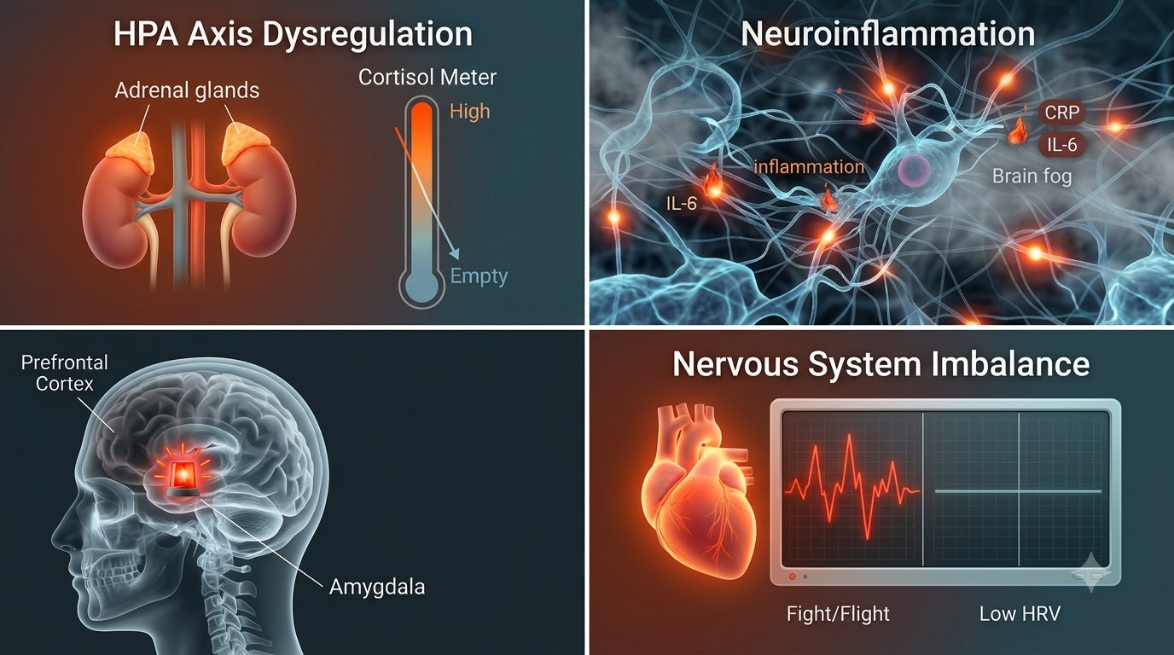
Burnout isn’t a medical diagnosis, yet its impact on the body is undeniable — which is why it fits naturally into our MindBody Series.
HPA axis dysregulation. The same stress-hormone cascade we discussed in Part 1 is central to burnout. Chronic occupational stress drives sustained activation of the hypothalamic-pituitary-adrenal (HPA) axis, leading to prolonged cortisol elevation followed — in some cases of severe burnout — by cortisol depletion as the system becomes exhausted. Studies have found both elevated and flattened cortisol profiles in people with burnout, suggesting the HPA axis response varies with the severity and duration of the condition.5
Neuroinflammation. As we covered in Part 4, chronic stress drives low-grade systemic inflammation. People with burnout consistently show elevated inflammatory markers — particularly CRP and IL-6 — contributing to the fatigue, brain fog, and mood changes characteristic of the condition.6
Structural brain changes. Neuroimaging studies have found measurable differences in the brains of people with clinical burnout. These include reduced grey matter volume in the prefrontal cortex (responsible for decision-making and emotional regulation), changes in amygdala reactivity, and altered connectivity in networks involved in attention and executive function. These changes are consistent with what chronic cortisol exposure does to the brain as described in Part 1.7
Autonomic nervous system imbalance. People with burnout show reduced heart rate variability; a marker of the balance between sympathetic and parasympathetic nervous system activity. Lower heart rate variability indicates a nervous system stuck in a state of chronic sympathetic activation the “fight or flight” mode that, as we have seen throughout this series, has wide-ranging consequences for physical and mental health.5
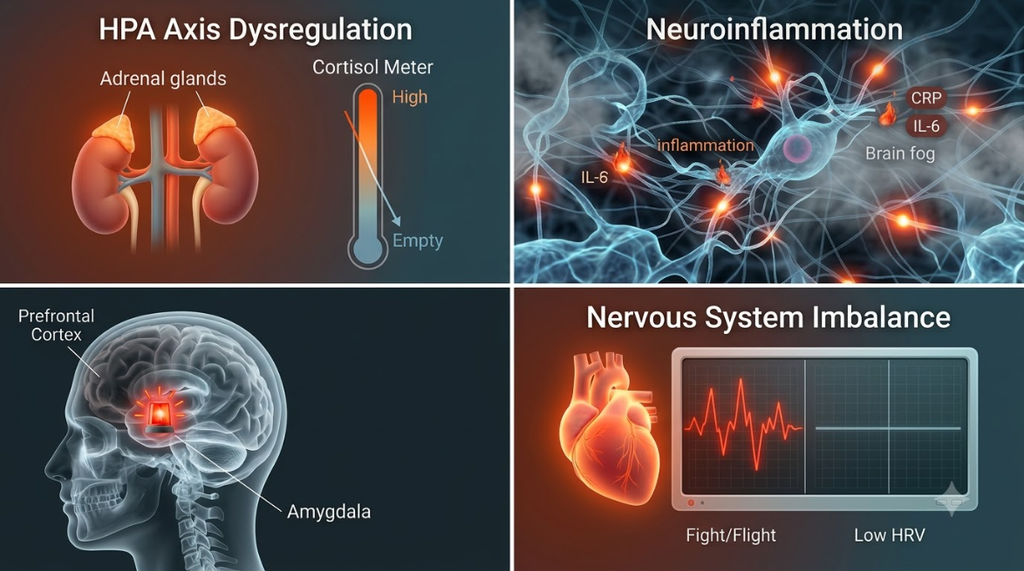
In other words, burnout may not be a medical diagnosis, but it produces the same physiological signatures as chronic stress because that is exactly what it is.
Why the Diagnosis Question Matters So Much
Burnout causes real changes in the body, but whether it’s officially labeled a medical condition matters. A medical diagnosis comes with a code that allows insurance coverage, sick leave, treatment plans, employer responsibilities, and research funding. Without that code, people with burnout often fall into a gap — too unwell to work, but without formal recognition or support. The WHO calls burnout an occupational phenomenon rather than a medical condition because science is still studying whether it’s truly separate from depression or anxiety.2,3 This doesn’t mean burnout isn’t real — it means research is still catching up with people’s lived experience.
What Actually Helps — The Evidence on Recovery
Whether or not burnout carries a formal diagnostic label, the evidence on what helps is reasonably clear.
Address the source. Since burnout is defined by its occupational origin, the most effective intervention begins with the workplace itself. Reducing workload, clarifying role expectations, increasing autonomy, and improving workplace social support have the most robust evidence for burnout prevention and recovery.1 Individual interventions without organizational change produce modest and often temporary effects.
Genuine rest — not just time off. Research highlights that real healing from stress comes when you stop thinking about work, not just when you’re physically absent. Checking emails on annual leave does not count as rest for the nervous system. The autonomic nervous system needs extended periods of parasympathetic activity to recover from chronic sympathetic overactivation.8
Sleep as intervention. As covered throughout this series, sleep is when the HPA axis resets and the brain consolidate and regulates emotional memories. In burnout, sleep is often severely disrupted and restoring sleep quality is a foundational step in physiological recovery.
Exercise. Regular moderate aerobic exercise reduces cortisol, lowers inflammatory markers, and improves prefrontal cortex function i.e., direct targeting of the three physiological signatures of burnout. Even 20–30 minutes three to four times a week has measurable effects.
Psychotherapy — particularly Cognitive behavioral therapy (CBT): helps people identify and modify the thought patterns and behaviors that sustain burnout perfectionism, difficulty saying no, identity fusion with work performance. It also provides tools for managing anxiety and low mood that frequently accompany the condition.3
Know when it has become depression. When exhaustion turns into lasting hopelessness or self harm thoughts, it’s no longer just burnout — it may be depression, and professional treatment is needed.
The Bottom Line
Burnout is real. The exhaustion is real. Cynicism is real. The cognitive fog, the inability to care about things that once mattered, the physical depletion is all real, all measurable, all rooted in the same stress biology, we have been exploring throughout this series.
What it is not at least yet, by the current scientific and clinical consensus is a medical diagnosis in the traditional sense. It is an occupational phenomenon with medical consequences. The distinction is not semantic. It shapes how we understand it, how we treat it, and how we prevent it.9
The most important practical takeaway is this: if you are experiencing what feels like burnout, take it seriously as a health matter — not because it has a diagnostic code, but because the physiology linked with it is real and the consequences of ignoring it are significant. Further, if the symptoms are pervasive, persistent, or accompanied by hopelessness, do not wait for the science to catch up. It is time to seek professional support now.
Your nervous system has been trying to tell you something. It is worth listening to.
Next in the series: The science of breathwork — which techniques actually work, why they work, and what the research says about using your breath to regulate your nervous system.
If you find this useful, subscribe to weekly evidence-based posts on mental health and mind-body science at The Health Explainer. If you are experiencing persistent symptoms of burnout or depression, please speak with a qualified healthcare professional.
Is Burnout a Real Medical Diagnosis? What the Science Actually Says?
References
- World Health Organization. Burn-out an “occupational phenomenon”: International Classification of Diseases. WHO; 2019. ICD-11 classification code QD85.
- Bianchi R, Schonfeld IS, Laurent E. Burnout-depression overlap: a review. Clinical Psychology Review. 2015;36:28–41.
- Demerouti, E. Burnout: a comprehensive review. Z. Arb. Wiss. 2024;78: 492–504.
- Koutsimani P, Montgomery A, Georganta K. The relationship between burnout, depression, and anxiety: a systematic review and meta-analysis. Frontiers in Psychology. 2019;10:284.
- Grossi G, Perski A, Evengård B, Blomkvist V, Orth-Gomér K. Physiological correlates of burnout among women. Journal of Psychosomatic Research. 2003;55(4):309–16.
- Toker S, Shirom A, Shapira I, Berliner S, Melamed S. The association between burnout, depression, anxiety, and inflammation biomarkers: CRP and fibrinogen in men and women. Journal of Occupational Health Psychology. 2005;10(4):344–62.
- Golkar A, Johansson E, Kasahara M, et al. The influence of work-related chronic stress on the regulation of emotion and on functional connectivity in the brain. PLoS ONE. 2014;9(9):e104550.
- Sonnentag S, Fritz C. The Recovery Experience Questionnaire: development and validation of a measure for assessing recuperation and unwinding from work. Journal of Occupational Health Psychology. 2007;12(3):204–21.
- Edú-Valsania S, Laguía A, Moriano JA. Burnout: A Review of Theory and Measurement. International Journal of Environmental Research and Public Health. 2022; 19(3):1780.
is burnout a medical diagnosis
is burnout a medical diagnosis, is burnout a medical diagnosis, is burnout a medical diagnosis, is burnout a medical diagnosis, is burnout a medical diagnosis, is burnout a medical diagnosis, is burnout a medical diagnosisis burnout a medical diagnosis, is burnout a medical diagnosis, is burnout a medical diagnosis,is burnout a medical diagnosis, is burnout a medical diagnosis, is burnout a medical diagnosis, is burnout a medical diagnosis, is burnout a medical diagnosis, is burnout a medical diagnosis, is burnout a medical diagnosis, is burnout a medical diagnosis