By Shilpa Khirbat | Medical Writer & Health Blogger | What Happens During a Panic Attack
This is Part 3 of the Mind-Body Series. Start from the beginning: [Part 1 — Why Mental Stress Makes You Physically Sick] | [Part 2 — Your Gut Has Its Own Brain]
Your heart is racing. Your chest is tight. You cannot catch your breath.” — short punchy sentences land harder than one long passive one. Further, tingling is experienced in hands and feet along with or without narrowed tunnel like vision. It appears as if every cell in the body is screaming that something is catastrophically wrong and that you are going to die now.
Strangely, everything passes within ten minutes and nothing is actually going to happen: no heart attack, no collapse and no emergency.
“If you have ever experienced a panic attack, you already know this is one of the most terrifying and confusing experiences a human being can have.” However, if you have never had one, it may be hard to understand why someone cannot simply “calm down” or “think their way out of it.”
The explanation lies in the neuroscience. A panic attack is neither actually an overreaction nor a weakness. It is your brain’s threat-detection system firing at full intensity with no off switch in sight.
Here is exactly what is happening inside your brain when it occurs:
The Amygdala: Your Brain’s Alarm System
To understand a panic attack, you first need to meet the amygdala.
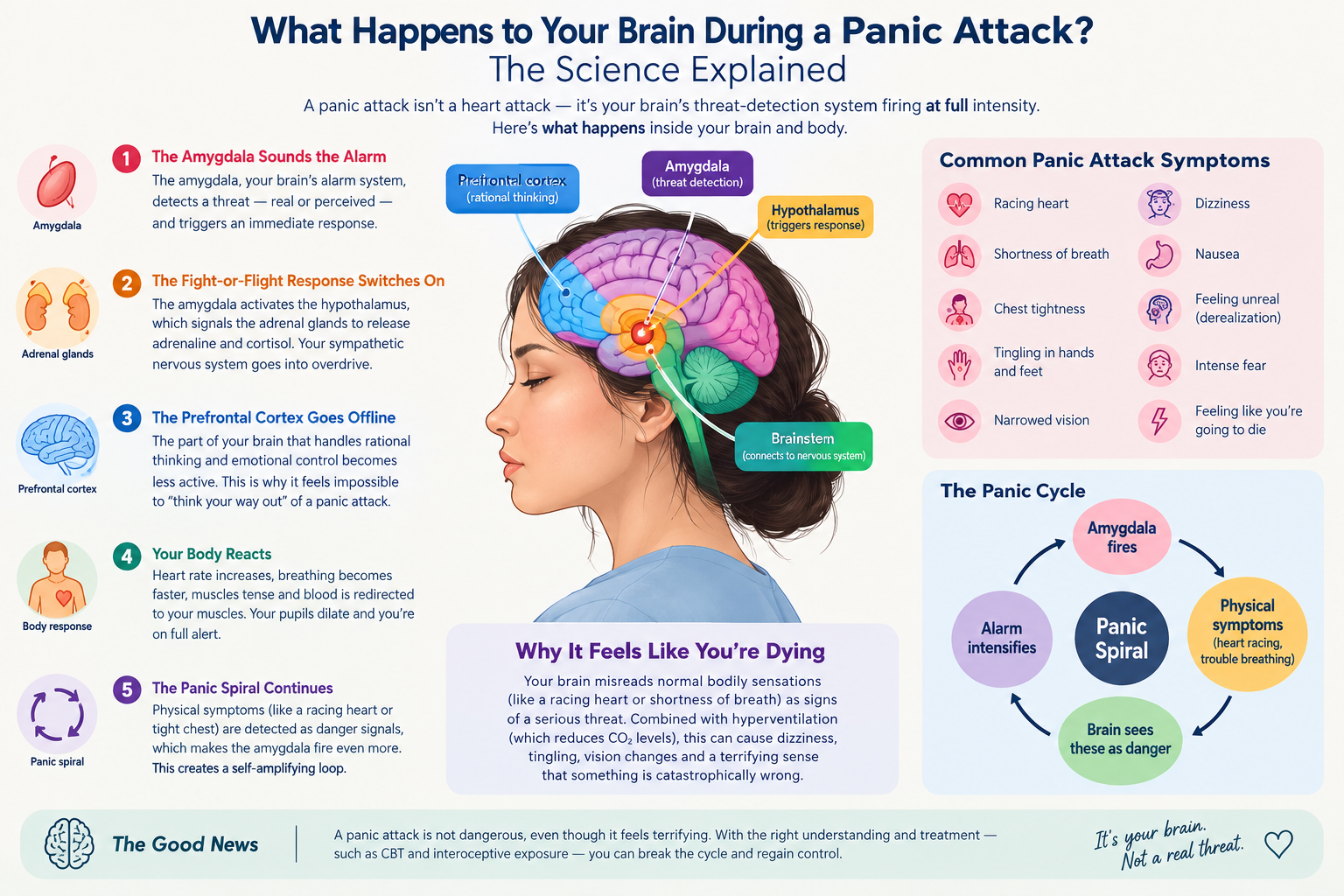
The amygdala is a small, almond-shaped structure located deep in the temporal lobe, one on each side of the brain. Its primary job is threat detection — scanning your environment and your internal state for anything that signals danger. When it identifies a real or perceived threat, it fires and triggers an immediate, system-wide emergency response.
In a fraction of a second, the amygdala activates the hypothalamus, which signals the adrenal glands to flood the bloodstream with adrenaline and cortisol. As soon as the sympathetic nervous system switches on, the heart rate spikes, breathing accelerates and the blood is redirected from your digestive system and skin to your muscles. During this time, your pupils dilate and the body is on full combat alert.
This is the fight-or-flight response we covered in Part 1 — but now running at maximum intensity, in the absence of any visible threat.
The Prefrontal Cortex Goes Offline
Normally, during ordinary stress, the Prefrontal Cortex takes the charge of evaluating the danger and decides whether it is real or a false alarm. However, during panic attack it shuts down or amygdala keeps the charge, sometimes known as “amygdala hijack” (a term coined by psychologist Daniel Goleman).1
This is precisely why telling someone in the middle of a panic attack to “just calm down” or “think rationally” is physiologically unhelpful. The part of the brain responsible for rational thought has been temporarily taken offline. The panic is not a choice. It cannot be reasoned away from the inside.
The Body Sends the Brain Deeper into Panic
Now comes the cruel feedback loop at the heart of panic disorder.
When the body enters the fight-or-flight state — heart racing, breathing fast and shallow, chest tight — these physical sensations are themselves detected as threatening signals. The amygdala, already primed and firing, interprets the racing heart as evidence of danger. The tight chest confirms something is wrong. The dizziness from hyperventilation (rapid and shallow breathing) suggests collapse.
The brain concludes: the threat is real. The alarm intensifies. The physical symptoms worsen. Which intensifies the alarm further.
This is the panic spiral — a self-amplifying loop between the brain and body that can escalate within seconds to a state of complete overwhelm.
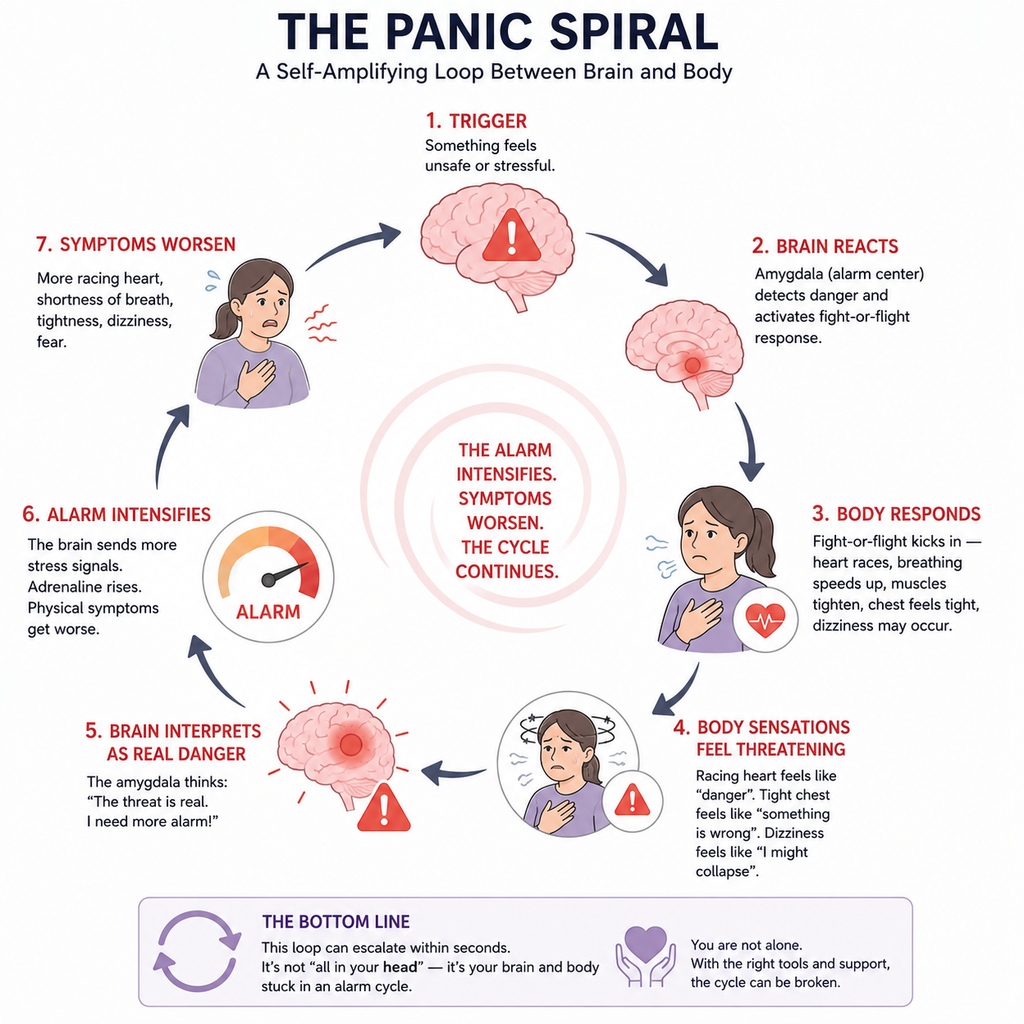
The role of hyperventilation, during a panic attack, in this process is particularly important. It drops the carbon dioxide levels in the blood which paradoxically causes the blood vessels to constrict and reduces oxygen delivery to the brain. The result: dizziness, tingling in the hands and feet, visual disturbances, and a terrifying sense of unreality known as derealization or depersonalisation.
The person experiencing this does not know their breathing has caused these sensations. They experience them as further evidence of catastrophic physical collapse. The loop tightens.
Why Your Brain Misreads the Threat
A central question in panic disorder research is: why does the amygdala fire in the first place, when there is no actual threat present?
The answer involves several converging factors:
Sensitisation. A brain that has been under sustained pressure for months or years is a brain with a hair-trigger alarm system. Minor internal sensations like a slightly elevated heart rate from caffeine or slight breathlessness from climbing stairs can be misread as the beginning of a threat response, which then becomes self-fulfilling.2
Interoceptive hypersensitivity. Research has shown that people prone to panic attacks tend to be more acutely aware of their body’s internal signals. This phenomenon is called interoceptive hypersensitivity.3 Brain imaging studies show differences in the insula (the brain region responsible for processing internal bodily sensations) in people with panic disorder. They literally perceive their heartbeat, breathing, and internal sensations more intensely than others.
The locus coeruleus. This small nucleus in the brainstem acts as the brain’s noradrenaline factory and plays a significant role in regulating arousal and the stress response. In people with panic disorder, the locus coeruleus appears to be chronically over-reactive, contributing to a baseline state of elevated alertness that makes the amygdala easier to trigger.4
Genetic and neurochemical factors. Panic disorder runs in families, suggesting a genetic predisposition. Imbalances in serotonin, GABA, and noradrenaline signalling all play a documented role — which is why both antidepressants (which modulate serotonin) and benzodiazepines (which enhance GABA activity) can be effective treatments.5
What a Panic Attack Actually Looks Like in the Brain
Brain imaging studies using fMRI and PET scans have given us a detailed picture of what is happening neurologically during a panic attack:
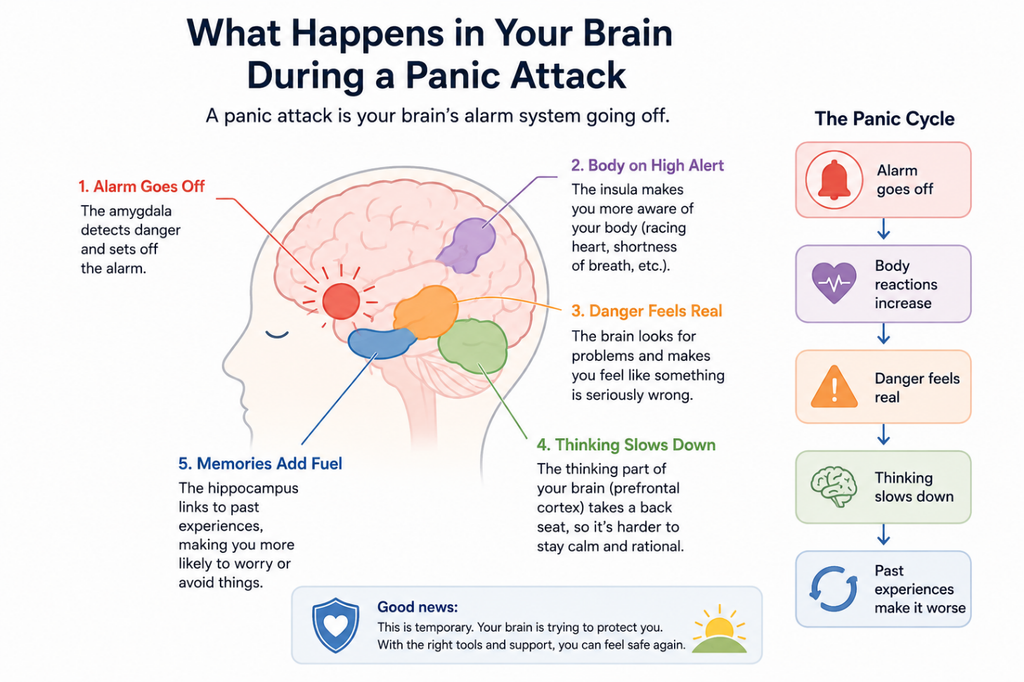
- Amygdala activation — consistently elevated, driving the threat response
- Prefrontal cortex suppression — reduced activity in the regions responsible for rational evaluation and emotional regulation
- Insula hyperactivation — heightened processing of internal bodily sensations, amplifying the perception of physical symptoms
- Anterior cingulate cortex changes — the region involved in error detection and conflict monitoring shows altered activity, contributing to the sense that something is catastrophically wrong
- Hippocampal involvement — the hippocampus, involved in contextual memory, plays a role in associating certain environments or sensations with past panic, contributing to anticipatory anxiety and avoidance behaviour.6
What this picture reveals is that a panic attack is not a single brain event. It is a cascade involving multiple interconnected regions, each amplifying the others in a system that has temporarily lost its capacity for self-regulation.
Panic Disorder vs. Panic Attack: An Important Distinction
It is worth clarifying an important distinction that is often blurred in popular discussion.
A panic attack is a discrete episode i.e., a sudden surge of intense fear with physical symptoms that peaks within minutes. Most people will experience at least one in their lifetime, often in response to extreme stress, sleep deprivation, caffeine excess, or an unusually stressful period.
Panic disorder is a clinical condition characterised by recurrent, unexpected panic attacks, combined with persistent worry about future attacks and significant changes in behaviour to avoid them. It affects approximately 2–3% of the global population and is one of the most treatable anxiety disorders when properly diagnosed and managed.7
This distinction is important because the experience of a single panic attack does not automatically indicate panic disorder. However, if panic attacks are recurring, are beginning to shape daily decisions, or are accompanied by persistent fear of future attacks, that warrants a conversation with a healthcare professional.
What Actually Helps — The Evidence
Given what we now know about the neuroscience of panic, the most effective interventions are those that directly target the amygdala-body feedback loop.
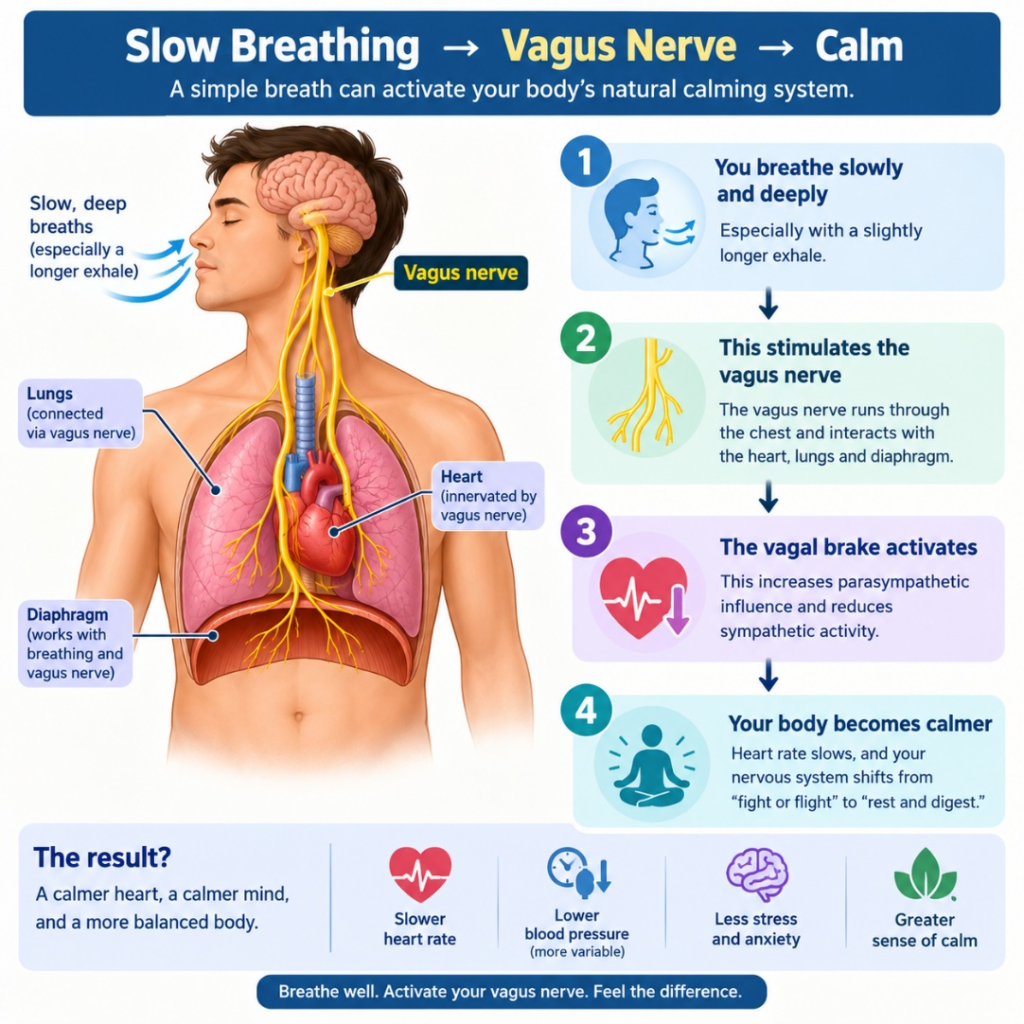
Controlled breathing — the fastest intervention. As covered in Part 1, slow diaphragmatic breathing with an extended exhale directly activates the vagus nerve and shifts the nervous system toward parasympathetic mode. During a panic attack, this means breathing in for 4 counts and out for 6–8 counts. This is not a relaxation technique — it is a direct neurological intervention. It raises carbon dioxide levels, dilates blood vessels, reduces the physical symptoms that are feeding the amygdala’s alarm signal, and begins to break the spiral.8
Cognitive Behavioural Therapy (CBT). CBT for panic disorder is one of the most rigorously evidenced psychological treatments in existence. It works by gradually rebuilding the prefrontal cortex’s regulatory influence over the amygdala — teaching the brain, through repeated exposure and cognitive reappraisal, that the sensations of panic are not dangerous. Over time, the amygdala’s sensitivity decreases and the rational brain regains its moderating role.5
Interoceptive exposure. A specific technique within CBT for panic disorder, interoceptive exposure involves deliberately inducing the physical sensations of panic — spinning in a chair, breathing through a straw, running on the spot — in a safe, controlled environment. This gradually desensitises the brain’s alarm response to these sensations, breaking the association between physical arousal and catastrophic threat.3
Reducing baseline arousal. As sensitisation and chronic stress lower the threshold at which the amygdala fires, anything that reduces baseline cortisol and sympathetic nervous system activity also reduces vulnerability to panic. Regular aerobic exercise, consistent sleep, reduced caffeine, and mindfulness practice all have documented effects on amygdala reactivity and panic frequency.
Medication when needed. SSRIs and SNRIs are first-line pharmacological treatments for panic disorder, working by modulating serotonin and noradrenaline signalling to reduce the overall excitability of threat-response circuitry. Benzodiazepines can provide rapid short-term relief but are generally not recommended for long-term use due to dependence risk. Both should be considered under medical supervision.
The Bottom Line
A panic attack feels like dying because your brain genuinely believes you are in mortal danger. Every system in your body responds accordingly — not because something is wrong with you, but because the most primitive and powerful survival circuitry in the human brain has been activated without a proportionate threat to justify it.
Understanding this does not make the experience less frightening in the moment. However, it changes the story you tell yourself about it and that story matters enormously for recovery.
You are not going mad. You are not physically dying. Your amygdala has fired, your prefrontal cortex has been temporarily overwhelmed and your body is doing exactly what it was designed to do. The task is learning how to interrupt the loop and the neuroscience gives us clear, evidence-based tools to do exactly that.
If panic attacks are affecting your daily life, please speak to a healthcare professional. Panic disorder is highly treatable and you do not have to manage it alone.
Next in the series: Is burnout a real medical diagnosis? — What the WHO classification actually means, and how to tell the difference between burnout and depression.
If you found this useful, consider subscribing to weekly evidence-based posts on mental health and the mind-body connection.
Next Blog – Your Gut Has Its Own Brain — And It Is Talking to Yours