By Shilpa Khirbat | Medical Writer & Health Blogger
This is Part 2 of our Mind-Body Series. If you missed Part 1, start here: Why Mental Stress Makes You Physically Sick.
When doctors say “trust your gut,” they actually mean it.
Your gastrointestinal tract, also known as the digestive system, is a long, winding tube that runs from mouth to rectum, containing over 100 million nerve cells.1 Scientists have named it “the enteric nervous system” because it is genuinely capable of sensing, processing, and responding to information entirely on its own — without waiting for instructions from the brain in your skull. Right now, it is constantly communicating with your brain without your knowledge.
Meet Your Second Brain
The enteric nervous system (ENS) is a mesh-like network of neurons embedded in the walls of your entire gastrointestinal tract. It runs from the oesophagus all the way down to the rectum, woven into two distinct layers of tissue.
The first layer is the myenteric plexus. Every time you swallow, food moves smoothly through you, and the myenteric plexus is quietly running the show. It sits between the muscle layers of the gut wall and controls movement through coordinated rhythmic contractions. These contractions are known as peristalsis.
The second layer is the submucosal plexus, which manages secretion and absorption. Being closer to the inner lining of the gut, it regulates the release of digestive fluid, the absorption of nutrients, and the gut lining’s response to its contents.
Together, these two networks enable the gut to operate completely independently — which is remarkable.
This is why neurogastroenterologist Michael Gershon named the ENS the second brain after decades of research.
The Vagus Nerve: A Motorway with Unexpected Traffic
The vagus nerve is the longest cranial nerve in the body. It extends from your brainstem down through your neck, chest, and abdomen, branching out to your heart, lungs, and gut. For a long time, scientists believed it functioned the way most people think the nervous system works — with the brain sending commands downward, and the body obeying.
The reality is almost the opposite.
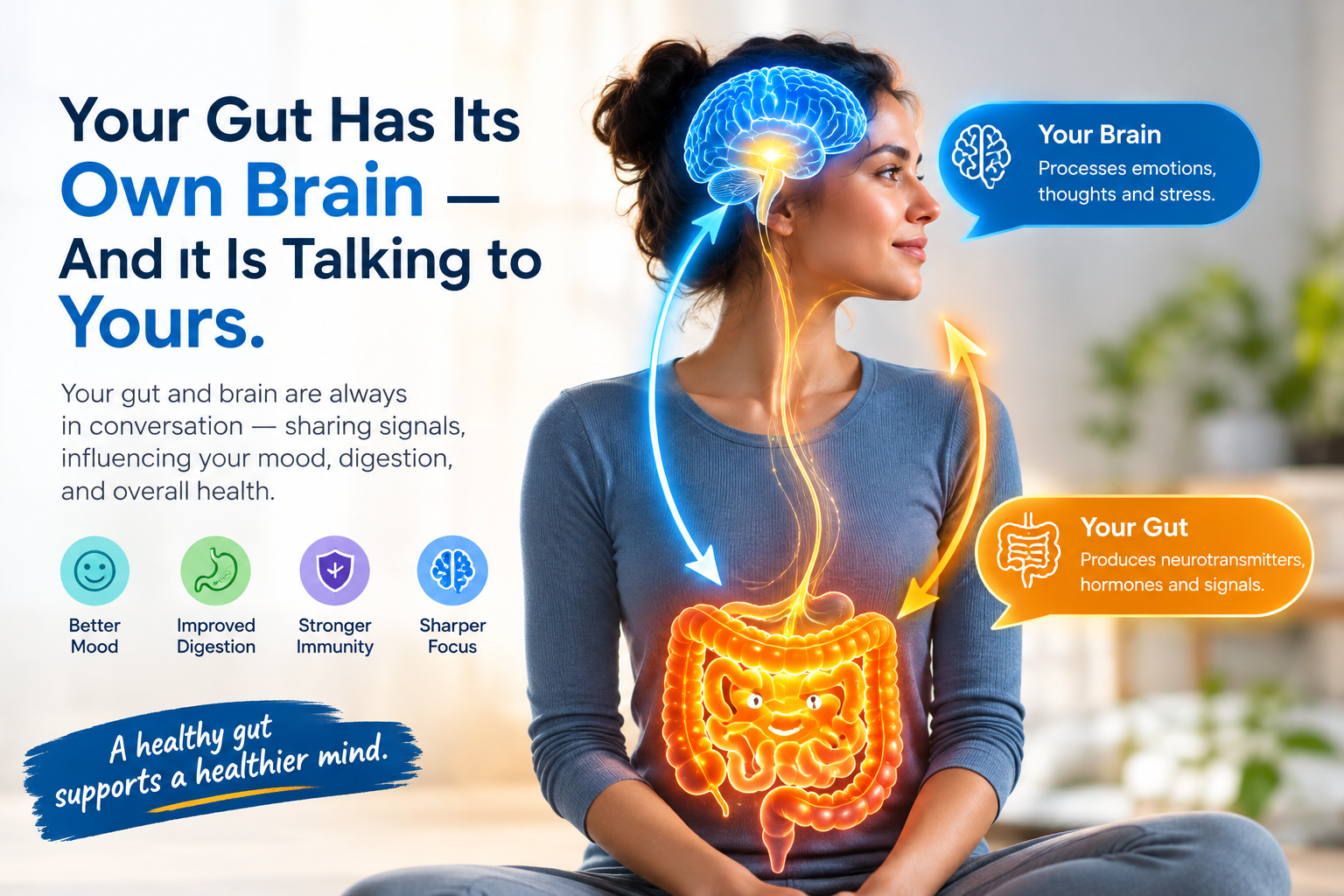
Approximately 90% of signals travelling along the vagus nerve move upward — from gut to brain, not the other way around.2 Your gut is not passively waiting for instructions; it constantly transmits reports on digestion, inflammation, gut bacteria composition, and crucially, information that influences your emotional state.
This is a profound shift in how we understand mood and mental health. Your brain does not generate your emotional experience in isolation. It constantly receives a stream of data from your gut and integrates that information into how you feel.
That flutter of anxiety before a difficult conversation? Your gut reported it before your conscious mind named it. The heavy, unsettled feeling after a difficult day? Your gut is involved in that too.
The Serotonin You Did Not Know You Had
Here is the fact that stops most people mid-sentence: approximately 90% of the body’s serotonin is produced in the gut, not the brain.3
Serotonin is most commonly discussed as the brain’s “feel-good” neurotransmitter — the chemical that antidepressants target. However, most of it is made by specialised cells called enterochromaffin cells, lining the gut wall. Gut serotonin regulates bowel movements, controls nausea responses, and plays a central role in the signals the gut sends upward to the brain.
This raises a question that researchers are actively exploring: if most serotonin is in the gut, and antidepressants work by increasing serotonin availability, what exactly are they doing to the gut, and does gut serotonin play a role in their effect on mood?
The honest answer is: we do not fully know yet. However, it is one of the most compelling open questions in neurogastroenterology, and the early research is genuinely fascinating.
What is already clear is this: your gut microbiome — the trillions of bacteria living in your intestines — directly influences how much serotonin is produced. Certain bacterial species stimulate enterochromaffin cells to produce more serotonin. Disrupting the gut microbiome disrupts serotonin production. The implications for mood, anxiety, and depression are significant and still unfolding.
The gut also produces other neurotransmitters: dopamine precursors are synthesised here, as is GABA — the brain’s primary calming neurotransmitter — produced by specific bacterial strains. The gut is not just a digestion machine. It is also a neurochemical factory.
When the Conversation Breaks Down
So far, we have established that your gut has its own nervous system, sends far more signals to the brain than it receives, produces most of the body’s serotonin, and communicates via a complex chemical and neural highway.
Now consider what happens when chronic stress enters the picture.
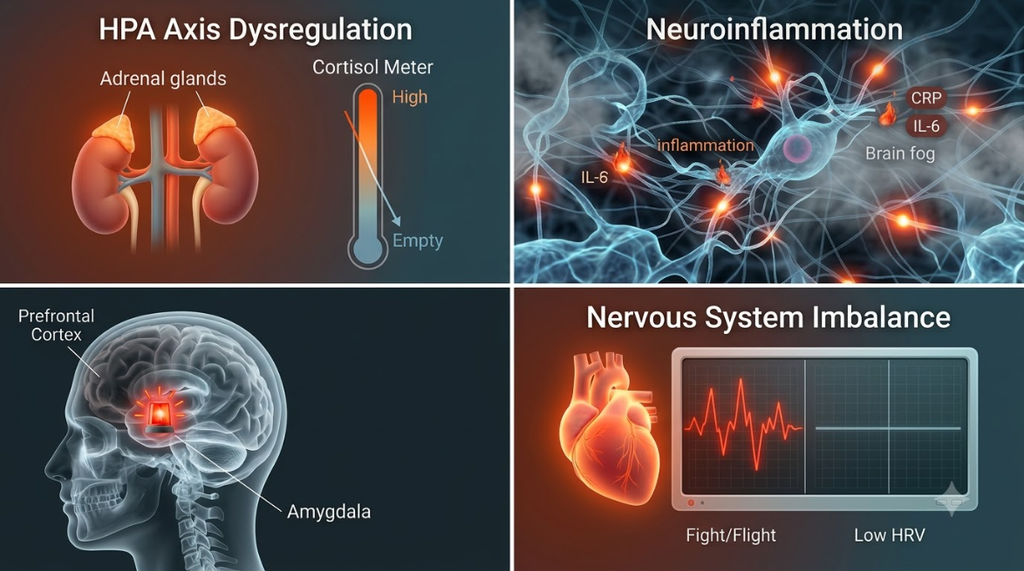
As we covered in Part 1, chronic stress keeps cortisol elevated and the sympathetic nervous system — the “fight or flight” side — turned on. This has direct and well-documented effects on the gut:
Gut motility changes. Stress accelerates motility in some people (diarrhoea, urgency) and slows it in others (constipation, bloating). This is the enteric nervous system responding to the same alarm signals as the rest of the body.
Gut permeability increases. The gut lining is normally a tightly regulated barrier, allowing nutrients in and keeping pathogens out. Under sustained stress, the tight junctions between gut lining cells can loosen a phenomenon often called “leaky gut.” During this condition, bacterial products and inflammatory molecules can pass into the bloodstream, triggering systemic inflammation.
The microbiome shifts. Stress hormones alter which bacterial species thrive in the gut. Research has shown that psychological stress can reduce the diversity of gut bacteria within days and a less diverse microbiome is consistently associated with poorer mental health outcomes, including anxiety and depression.4
The feedback loop locks in. A disrupted gut sends dysregulated signals upward to the brain, worsening anxiety and mood. That worsened anxiety then further disrupts the gut. The two systems are caught in a loop, each making the other worse.5
This is why irritable bowel syndrome (IBS), which affects an estimated 10–15% of the global population has such strong bidirectional links with anxiety and depression.6 Treating the brain alone, or the gut alone, often produces incomplete and frustrating results. Effective treatment increasingly recognises that you have to address both ends of the axis.
Let Us Examine Our Gut Feeling Right Now
Take a moment and notice your gut right now. Does it feel calm? Tight? Unsettled for no clear reason?
Your brain is constantly listening to signals from inside your body a process called interoception. And one of its clearest voices is the gut.
Research in affective neuroscience shows that people who are more aware of these internal signals often have better emotional regulation, resilience, and self-awareness.
So, paying attention to your “gut feeling” is not overthinking or navel-gazing. It is your brain reading the state of your body. It is neuroscience.
What You Can Do to Support the Gut-Brain Axis
The good news is that the gut-brain axis responds well to intervention. Here is what the current evidence supports:
Feed your microbiome. Diversity of gut bacteria is associated with better mental health outcomes. A diet rich in fibre (vegetables, legumes, wholegrains), fermented foods (yoghurt, kefir, kimchi, sauerkraut), and polyphenols (berries, olive oil, green tea) supports a diverse and resilient microbiome. This is one of the most well-supported nutritional interventions in the field.
Stimulate the vagus nerve. The vagus nerve is the physical connection between your gut and your brain — and you can activate it deliberately. Deep diaphragmatic breathing, humming, cold water splashed on the face, and slow exhalation all stimulate vagal tone and shift the nervous system toward parasympathetic mode. These are not wellness trends. They are evidence-based techniques with measurable physiological effects.
Eat mindfully and slowly. Eating quickly under stress keeps the sympathetic nervous system activated, suppressing digestive function. Slowing down — even just chewing more thoroughly — activates the parasympathetic “rest and digest” response and allows the gut to function as it is designed to.
Be cautious with unnecessary antibiotics. Antibiotics save lives and are sometimes essential. However, unnecessary use significantly disrupts the gut microbiome, and the downstream effects on mood and mental health are an area of active research. This is not an argument against antibiotics when needed — it is an argument for not taking them when they are not needed.
Consider probiotics thoughtfully. The evidence for probiotics in mental health is emerging and genuinely promising, particularly for specific strains in anxiety and low mood. However, this field is moving quickly, and not all probiotic products are equivalent. If you are considering probiotics for mental health reasons, it is worth discussing with a healthcare professional rather than picking a product off the shelf.
The Bottom Line
Hidden within your digestive system is a powerful communication network that constantly communicates with your brain. It monitors your internal environment, helps produce chemicals that influence mood, shapes your emotional state, and sends a steady stream of information to your brain — most of it without you ever noticing.
Mental health is not just about what is happening in your head. Your gut and brain are in constant conversation through what is known as the gut-brain axis. When your gut is thriving, it can support better mood, focus, and emotional wellbeing. When it is struggling, your mind often feels it too.
The science is becoming increasingly clear: taking care of your gut is not just about digestion. It is an essential part of maintaining your mental health.
Next in the series: What happens to your brain during a panic attack — the neuroscience of fear, the amygdala, and why it feels like your body is betraying you.
If you found this useful, consider subscribing to weekly evidence-based posts on mental health and the mind-body connection. If you are experiencing persistent gut symptoms, anxiety, or low mood, please speak with a qualified healthcare professional.
Links back to Post #1 (Why Mental Stress Makes You Physically Sick)