By Shilpa Khirbat | Medical Writer & Health Blogger
Cold plunges and mental health | This is Part 10 of the Mind-Body Series at The Health Explainer. Read the full series: [Part 1] | [Part 2] | [Part 3] | [Part 4] | [Part 5] | [Part 6] | [Part 7] | [Part 8] | [Part 9] | [Part 11 — Sleep: The Night-Time Conversation]
Cold water immersion has become one of the defining wellness trends of the past five years. Influencers film themselves climbing into ice baths at dawn. Tech executives credit cold plunges with sharper thinking and better mood. Andrew Huberman has discussed the noradrenaline response on every platform imaginable and ice barrel manufacturers cannot keep up with demand.
As with every wellness trend, the critical question is not whether people feel better after a cold plunge, because there is little doubt that many do.. The question is whether that experience reflects a genuine, replicable, biologically meaningful effect, or whether it is a combination of placebo response, the natural reward of doing something difficult, and very effective social media marketing.
The honest answer, as a medical writer who has reviewed the literature carefully, is: somewhere in between and considerably more nuanced than either the enthusiasts or the sceptics usually admit.
Here is what the evidence actually shows.
Why Cold Plunges Went Mainstream
The modern cold plunge movement has several intersecting origins.
Wim Hof “The Iceman” brought cold water immersion to global attention through his documented ability to withstand extreme cold and his associated breathing technique. While some of his more dramatic claims remain scientifically unverified, his public profile sparked genuine scientific curiosity and a wave of research interest.
Simultaneously, the growth of biohacking culture — the use of lifestyle interventions to optimise physical and mental performance created an audience actively searching for evidence-based tools beyond conventional medicine. Cold exposure fitted neatly: cheap, accessible, time-efficient, and generating an immediate, visceral physiological response.
The neuroscience content creator Andrew Huberman amplified specific mechanisms — particularly the noradrenaline and dopamine response to cold exposure and gave the trend a scientific vocabulary that resonated with an audience that wanted more than testimonials. Whether the science supports the enthusiasm is a separate question.
What Happens to Your Body in Cold Water — The Physiology
Before evaluating the mental health claims, understanding the acute physiological response to cold water immersion is essential:
The Cold Shock Response
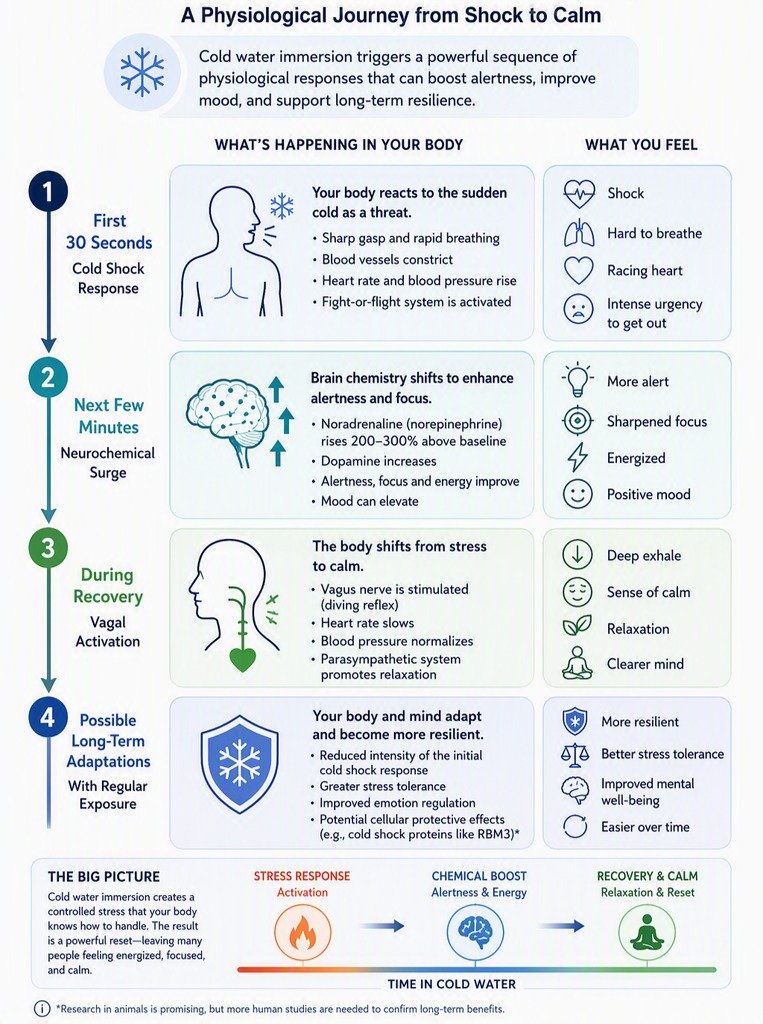
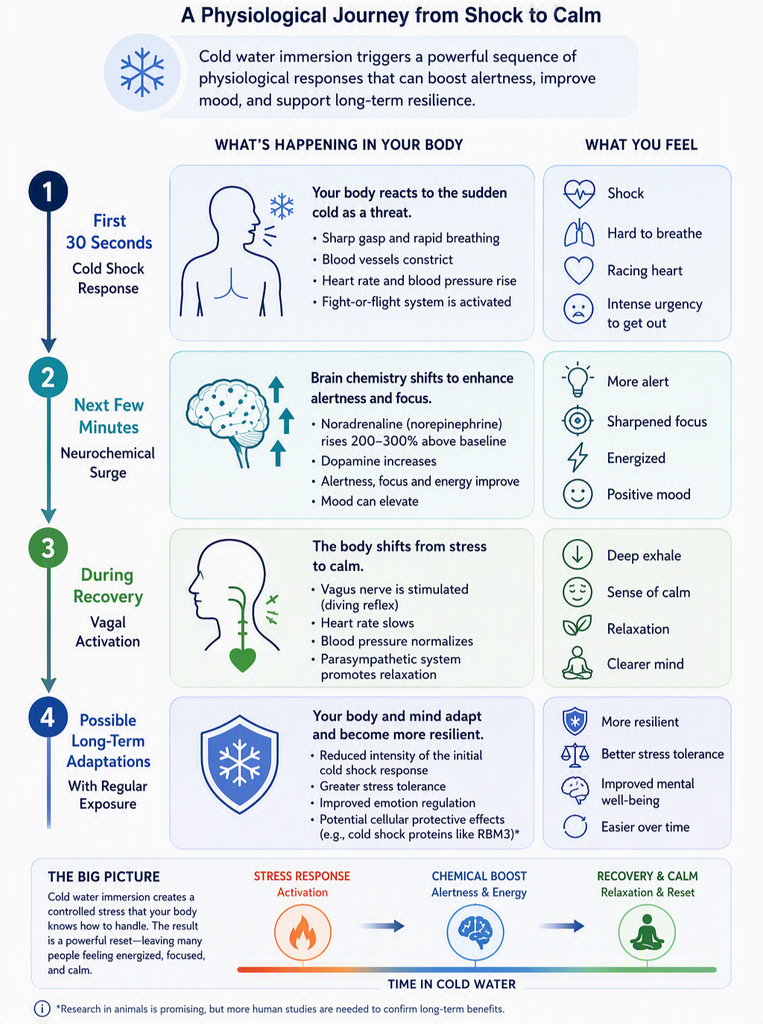
The first few seconds in cold water trigger a powerful and involuntary reaction known as the cold shock response. Breathing becomes rapid, a sharp gasp often occurs, blood vessels narrow, and both heart rate and blood pressure rise quickly. These changes reflect activation of the sympathetic nervous system, the body’s built-in “fight-or-flight” response to a sudden environmental stressor.1
Repeated exposure reduces the intensity of this reaction in most people. Breathing becomes easier to control, the initial gasp becomes less pronounced, and the cardiovascular response is more restrained. This process of adaptation, known as habituation, may contribute to greater tolerance of physical and psychological stress.
The Noradrenaline Surge (A Surge in Alertness Chemicals)
One of the most studied effects of cold-water immersion is the release of noradrenaline (also called norepinephrine), a brain chemical involved in alertness, attention, motivation, and mood.
Cold water immersion produces a substantial and rapid increase in plasma noradrenaline in some studies, increases of 200–300% above baseline. Cold exposure also appears to increase dopamine, another neurotransmitter associated with motivation and well-being.2
Noradrenaline is a key neurotransmitter involved in attention, arousal, mood regulation, and stress response. The sharp noradrenaline spike produced by cold immersion is followed by a sustained elevation that can last for several hours. Many researchers believe this surge helps explain why people often report feeling energized, focused, and mentally refreshed after a cold plunge.
This is one of the strongest scientific explanations for the immediate mood boost that many cold-plunge enthusiasts describe.
Cold Shock Proteins (Protective Responses in the Brain)
Cold exposure stimulates the production of cold shock proteins — particularly RNA-binding motif protein 3 (RBM3) — which have been shown in animal studies to protect against synaptic loss and neurodegeneration.3 Research in mouse models of Alzheimer’s disease found that cold-induced RBM3 production was neuroprotective.
While these findings are promising, most of the evidence currently comes from laboratory and animal research. Scientists are still investigating whether the same benefits occur in humans using real-world cold plunge practices.
Vagal Stimulation (The Nervous System Rebalance)
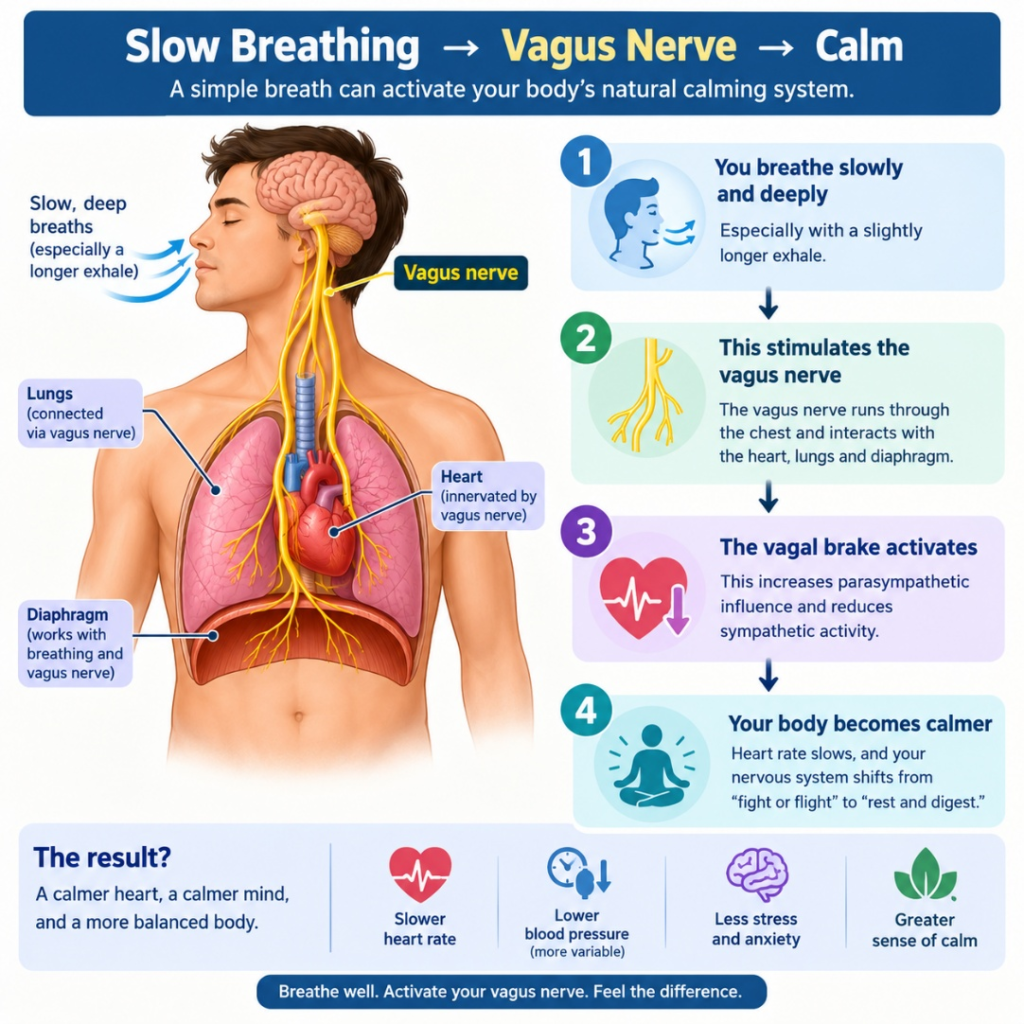
Cold water on the face and to a lesser extent full-body immersion stimulates the vagus nerve through the diving reflex, producing a rapid parasympathetic response that slows heart rate and reduces sympathetic activation. This is the same vagal stimulation discussed in Parts 2 and 6, achieved through a different route.4
The calming effect many people report after the initial cold shock subsides is partly attributable to this vagal activation i.e., the nervous system swinging from acute sympathetic activation into parasympathetic recovery.
| What You Feel | What’s Happening in Your Body |
|---|---|
| Sudden shock | Activation of the sympathetic nervous system |
| Racing heart | Increased heart rate and blood pressure |
| Feeling alert | Release of noradrenaline and dopamine |
| Feeling accomplished | Successful adaptation to an acute stressor |
| Feeling calm afterward | Increased parasympathetic (vagal) activity |
| Easier over time | Habituation of the cold shock response |
Key Takeaway
Cold water immersion triggers a sequence of physiological responses rather than a single effect. An initial stress response is followed by surges in neurochemicals associated with alertness, activation of cellular stress-response pathways, and a subsequent shift toward recovery and relaxation. Together, these mechanisms provide a biologically plausible foundation for many of the psychological effects reported by cold-plunge practitioners.
What the Research Actually Shows
Depression and Anxiety — What the RCTs Show
The clinical evidence for cold water immersion as a treatment for depression and anxiety is promising but limited. This is an important distinction: promising but limited means we should be interested, not convinced.
A case study published in BMJ Case Reports in 2018 described a 24-year-old woman with major depression and anxiety who achieved remission through a weekly cold water swimming programme, allowing gradual reduction of her antidepressant medication. 5 This is intriguing but represents the lowest level of clinical evidence — a single case.
A 2023 randomised controlled trial published in PLOS ONE found that cold water swimming over several weeks produced significant improvements in mood, energy levels, and wellbeing compared with a control group — with effects sustained at follow-up.6 This is more encouraging, but the sample size was modest and the study did not control for the social component of group swimming or the effect of regular outdoor exercise.
A systematic review published in International Journal of Circumpolar Health in 2022 concluded that there was preliminary evidence for beneficial effects of cold-water immersion on mood and wellbeing, but called for larger, more rigorous trials before clinical recommendations could be made.7
The honest summary: the evidence is not yet at the level that justifies cold plunging as a clinical recommendation for depression or anxiety. The mechanistic case is plausible. The early trial data is encouraging. The large, well-controlled RCTs have not yet been done.
The Dopamine Effect — Real but Misunderstood
Huberman and others have described a sustained dopamine increase following cold water immersion with some research suggesting dopamine levels remain elevated for hours after a cold plunge.2
This is real, and it is significant. Dopamine is central to motivation, anticipatory reward, and mood regulation. A rise in dopamine after cold exposure may help explain why many people feel more motivated, upbeat, and mentally energized for several hours after a morning cold plunge.
However, the dopamine response to cold immersion is not unique to cold immersion. Exercise, social connection, achievement, and creative engagement all produce dopamine responses — some of which are better studied and have stronger clinical evidence. Cold immersion is one route to dopamine elevation, not the only one.
Athletic Recovery — The Stronger Evidence Base
The strongest evidence for cold water immersion is not in mental health but in athletic recovery. Multiple well-controlled trials have found that cold-water immersion after intense exercise reduces delayed onset muscle soreness, accelerates recovery of force production, and may reduce exercise-induced inflammation.1
This is where cold water immersion has the most robust evidence and it is worth noting that much of the positive public perception of cold plunging may be driven by athletic populations reporting genuine physical recovery benefits, with those benefits being extrapolated to mental health contexts where the evidence is considerably thinner.
Recent Research: Stress, Wellbeing, and Brain Function
A 2025 systematic review and meta-analysis published in PLOS ONE — the most comprehensive review of cold water immersion health outcomes to date, covering outcomes including mood, stress, fatigue, depression, and anxiety — found that cold water immersion produced significant reductions in stress immediately post-exposure, with effects sustained at 24 hours.8 A 2023 fMRI study in Biology found that even a single bout of short-duration cold water immersion increased connectivity between large-scale brain networks involved in emotional regulation — including the prefrontal cortex, anterior insula, and anterior cingulate cortex — and shifted the ratio of positive to negative affect from 1.75 before immersion to 3.00 after, a threshold researchers associate with flourishing mental wellbeing.9 A 2025 systematic review protocol published in Frontiers in Psychiatry noted that while anecdotal evidence is strong, the scientific evidence base remains fragmented and called for large-scale, well-controlled trials — the most rigorous assessment yet of what we do and do not know.10
TRAFFIC-LIGHT EVIDENCE MAP
COLD PLUNGES: WHAT DOES THE EVIDENCE ACTUALLY SHOW?
| Evidence Level | What the Research Says |
|---|---|
| 🟢 Well Supported | • Athletic recovery¹ • Reduced muscle soreness¹ • Increased alertness and energy² • Measurable physiological effects² |
| 🟡 Encouraging Early Evidence | • Improved mood and wellbeing⁶ • Reduced perceived stress⁸ • Better emotional regulation⁹ • Reduced anxiety symptoms⁷ • Greater stress resilience⁷ |
| 🔴 More Research Needed | • Treatment for depression⁵⁻⁷ • Replacement for therapy or medication⁵⁻⁷ • Long-term mental health benefits7-10 • Neuroprotection in humans³ |
Table 1: Current state of the evidence for cold-water immersion. Green indicates outcomes supported by relatively consistent evidence, amber indicates promising but still developing evidence, and red indicates areas where evidence remains insufficient for clinical recommendations.
What the Research Does Not Show
In the spirit of the evidence-based approach that defines this series, it is worth being explicit about what the cold plunge literature does not support.
Cold plunging does not cure depression. The single case study of a woman achieving remission is not clinical evidence for a treatment. Depression is a heterogeneous condition requiring proper assessment and evidence-based treatment CBT, medication, exercise, and the other interventions described in this series.
The cognitive enhancement claims are overblown. Claims that cold plunges produce dramatic improvements in cognitive performance, creative thinking, or long-term neuroplasticity in humans are not well supported by current evidence. The noradrenaline response improves acute alertness, that is real. Durable cognitive enhancement through cold exposure alone is not established.
More is not better. Cold water immersion is a physiological stressor. Excessive cold exposure particularly in untrained individuals or those in compromised health can produce adverse cardiovascular effects. There is no evidence that longer or colder translates to greater mental health benefits.
Who Should Not Do Cold Plunges
Cold water immersion is not appropriate for everyone, and this is a point that wellness culture frequently neglects. People with the following conditions should consult a doctor before attempting cold water immersion:
- Cardiovascular disease, including arrhythmias, hypertension, or a history of heart attack or stroke — the cold shock response produces acute cardiovascular stress
- Raynaud’s disease — cold exposure triggers severe peripheral vasoconstriction
- Peripheral vascular disease
- A history of seizures
- Pregnancy
- Any condition affecting temperature regulation
The acute cardiovascular response to cold immersion is not trivial. Cold water drowning deaths occur even in experienced swimmers — the cold shock response can trigger cardiac arrest in vulnerable individuals. This is not a reason to avoid cold immersion entirely, but it is a reason to approach it with appropriate caution and medical awareness.
A Balanced Verdict — Is It Worth Trying?
For healthy individuals without contraindications, the evidence supports giving cold water immersion a cautious, graduated trial — not as a treatment for mental health conditions, but as a complementary tool for mood, alertness, and stress resilience.
The acute noradrenaline and dopamine response is real and well-documented. The vagal stimulation effect is real. The mood benefits reported by regular practitioners are plausible given these mechanisms and the practice of doing something genuinely difficult voluntarily confronting physical discomfort and habituating to it has its own psychological value that is difficult to quantify but should not be dismissed.
If you are considering trying cold water immersion:
- Start gradually — cold showers before cold baths, 30 seconds before 2 minutes
- Aim for water temperatures between 10–15°C (50–59°F) for meaningful physiological response
- Do not do it alone initially, particularly in open water
- Morning immersion appears to produce the most sustained noradrenaline and dopamine elevation through the day
- Consistency appears to matter more than intensity — regular brief exposures produce adaptation and sustained benefit
- Do not replace evidence-based treatment for depression or anxiety with cold plunging
The Bottom Line
Cold plunges clearly produce real physiological effects and may improve mood, alertness, and perceived stress in the short term. Evidence for mental health benefits is encouraging, but the strongest claims currently exceed the available evidence. Athletic recovery remains the area with the most robust scientific support.
Cold water immersion may be a useful addition to a broader wellbeing toolkit, alongside exercise, sleep, social connection, and other evidence-based practices. It is not a replacement for them.
For now, the most accurate verdict is simple: interesting, promising, and not yet proven.
One More Conversation to Go
This is Part 10 of eleven. We have covered the stress response and cortisol, the enteric nervous system and gut-brain axis, the neuroscience of panic, chronic inflammation, burnout, breathwork, magnesium, exercise, loneliness, and cold-water immersion.
One final chapter remains — and it may be the most important of all.
Next in the series: Sleep: The Night-Time Conversation —what your brain is doing while you sleep, why the glymphatic system matters, and the gold-standard treatment for insomnia most people have never heard of.”
The thread running through all eleven posts is the same: your mind and your body are not separate systems. They are one system — communicating constantly, influencing each other profoundly, and responding to the same biological signals.
Understanding that connection does not just change how we think about health. It changes what we do about it.
If you found this series useful, subscribe to weekly evidence-based posts on mental health and mind-body science at The Health Explainer. All posts in the series are available in ebook format — download free for subscribers.
Cold Plunges And Mental Health
References
- Tipton MJ, Collier N, Massey H, Corbett J, Harper M. Cold water immersion: kill or cure? Experimental Physiology. 2017;102(11):1335–55.
- Šrámek P, Šimečková M, Janský L, Šavlíková J, Vybíral S. Human physiological responses to immersion into water of different temperatures. European Journal of Applied Physiology. 2000;81(5):436–42.
- Peretti D, Bastide A, Radford H, et al. RBM3 mediates structural plasticity and protective effects of cooling in neurodegeneration. Nature. 2015;518(7538):236–9.
- Esperland D, de Weerd L, Mercer JB. Health effects of voluntary exposure to cold water — a continuing subject of debate. International Journal of Circumpolar Health. 2022;81(1):2111789.
- van Tulleken C, Tipton M, Massey H, Harper CM. Open water swimming as a treatment for major depressive disorder. BMJ Case Reports. 2018;2018:bcr2018225007.
- Kelly JS, Bird E. Improved mood following a single bout of cold water swimming — a randomised controlled trial. PLOS ONE. 2022;17(4):e0266048.
- Esperland D, de Weerd L, Mercer JB. Health effects of voluntary exposure to cold water — a continuing subject of debate. International Journal of Circumpolar Health. 2022;81(1):2111789.
- Cain CL, Saeed S, Sanaee S, et al. Effects of cold-water immersion on health and wellbeing: a systematic review and meta-analysis. PLOS ONE. 2025;20(1):e0317615.
- Yankouskaya A, Williamson R, Stacey C, et al. Short-term head-out whole-body cold-water immersion facilitates positive affect and increases interaction between large-scale brain networks. Biology. 2023;12(2):211.
- Schepanski S, Batta M, Schröter L, Seifert G, Koch G. Protocol for a systematic review and meta-analysis on the effects of cold-water exposure on mental health. Frontiers in Psychiatry. 2025;16:1603700.