By Shilpa Khirbat | Medical Writer & Health Blogger
Exercise for Depression | Part of the Mind-Body Series at The Health Explainer. Catch up here: [Part 1 — Why Mental Stress Makes You Physically Sick] | [Part 2 — Your Gut Has Its Own Brain] | [Part 3 — What Happens to Your Brain During a Panic Attack] | [Part 4 — How Chronic Inflammation Connects Body and Mind] | [Part 5 — Is Burnout a Real Medical Diagnosis?] | [Part 6 — The Science of Breathwork] | [Part 7 — Do Magnesium Supplements Actually Reduce Anxiety?]
You have probably been told, at some point in your life, to exercise more for your mental health.
It can come from anywhere: a conversation with your doctor, an article that catches your eye, or a comment from someone close to you, offered with love but landing at the worst possible time.
If you were going through a difficult period when that advice arrived, your reaction was probably less than enthusiastic. You may have rolled your eyes, felt irritated, or quietly dismissed it altogether. From the outside, exercise seems straightforward. Put on your shoes, step outside, and start moving. Depression and chronic anxiety tell a very different story. What looks simple to others can feel enormous from the inside. Energy becomes scarce. Motivation fades. Activities that once brought joy seem strangely distant. Even small tasks can demand a surprising amount of effort. In that state, the suggestion to “get some exercise” can feel disconnected from reality. That disconnect is precisely what makes this topic worth exploring. This article is not another appeal to willpower. It is not here to suggest that exercise is easy, nor to imply that struggling individuals simply need to try harder. The scientific evidence supporting exercise as a mental health intervention is remarkably strong. At the same time, there is equally compelling evidence explaining why getting started can feel so difficult. The very symptoms that exercise may help alleviate, such as fatigue, low motivation, emotional numbness, and a sense of physical heaviness, are often the same symptoms that make movement feel impossible in the first place.
Understanding that paradox is the real starting point. The story is not only about why exercise works. It is also about why taking the first step can feel so hard, and what research tells us about making that step a little easier.
Here is what the research actually shows.
Exercise as “Nature’s Antidepressant” — What the Science Really Says
You’ve probably heard the phrase: “Exercise is nature’s antidepressant.” It’s catchy, memorable, and widely repeated in health conversations. Unlike many health slogans, this one is backed by solid evidence.
Research, including large systematic reviews and meta-analyses (the highest level of clinical evidence), shows that regular physical activity can significantly reduce symptoms of depression and anxiety. These improvements are not small — they are strong enough to compare with established treatments.1
Still, the slogan tells only part of the story. Exercise is not a one-size-fits-all prescription. Important questions remain:
- Which types of exercise are most effective?
- How much and how often is needed?
- Do certain groups benefit more than others?
- Under what circumstances does exercise work best?
These details matter. They help us understand what’s happening in the brain and how to translate the science into practical strategies that fit real lives.
The bottom line: exercise truly has antidepressant effects, but the way it works depends on the individual and the context. Recognizing these nuances allows us to move beyond slogans and toward personalized approaches that maximize the mental health benefits of physical activity.
What Happens in Your Brain When You Exercise
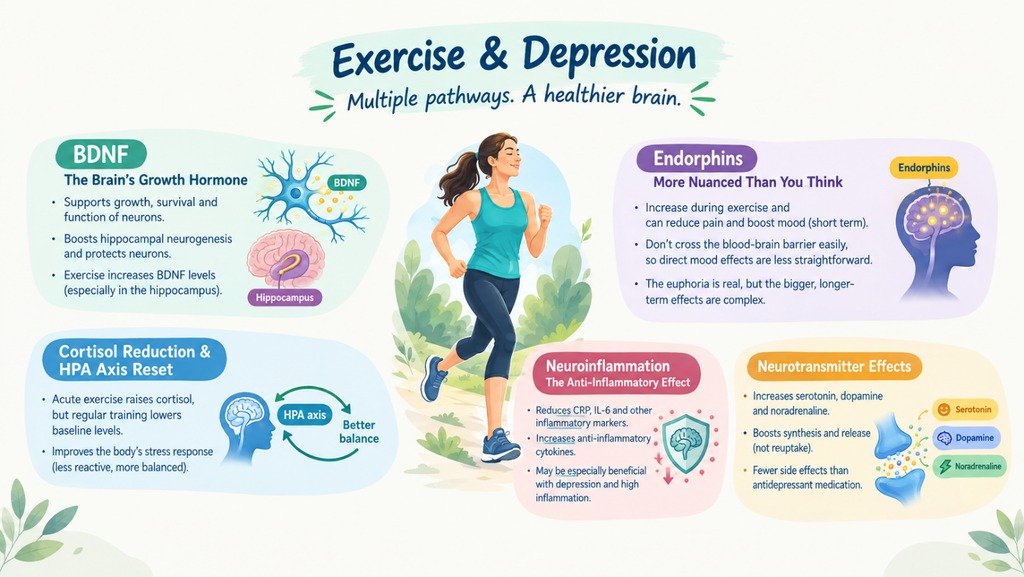
Exercise doesn’t just build stronger muscles — it reshapes the brain. That’s what makes it so powerful, and also why no single pill can fully copy its effects. Here’s the step-by-step journey:
- BDNF — Fertilizer for the Brain The first big change comes from brain-derived neurotrophic factor (BDNF), often called “fertilizer for the brain.” Even a single workout raises BDNF levels, and regular aerobic activity produces lasting increases, especially in the hippocampus — the brain’s center for memory, learning, and emotional regulation. BDNF helps grow new brain cells, protects existing ones, and counters the damage caused by chronic stress. Since stress and high cortisol can shrink the hippocampus, BDNF acts as a shield, keeping the brain resilient and adaptable.2
- Endorphins — The Immediate Lift As you move, your body releases endorphins. These natural “feel-good” chemicals ease pain and create a short burst of euphoria — the famous runner’s high. They explain the immediate pleasure of exercise, even if they don’t fully account for its long-term antidepressant effects.3
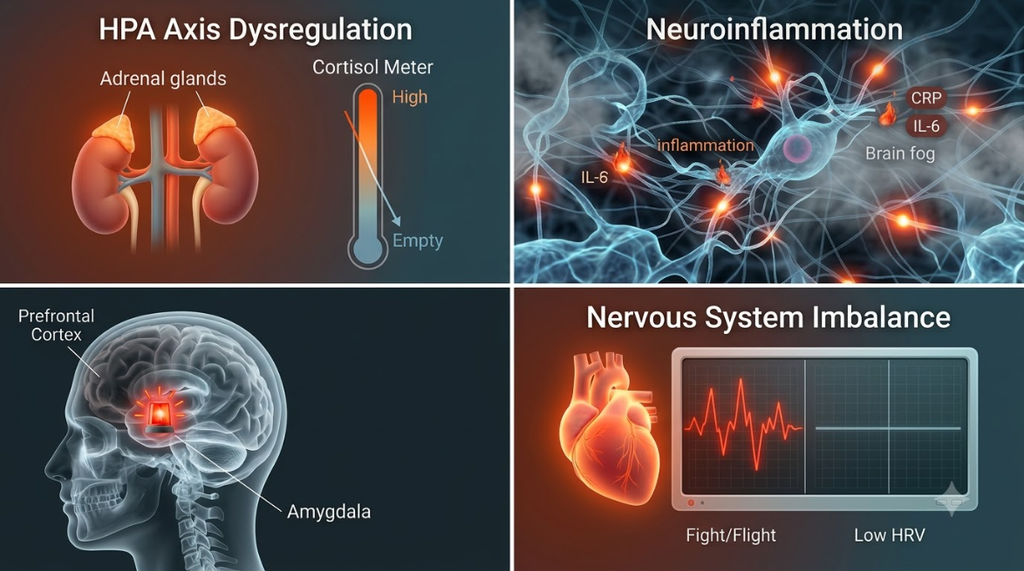
- Cortisol Reset — Training the Stress System: Exercise temporarily raises cortisol because physical activity is a stressor. With regular training, though, your stress system learns to reset more efficiently. Baseline cortisol levels drop, and the body becomes better at handling stress without staying stuck in overdrive. This is crucial because depression is often linked to chronically high cortisol.4
- Inflammation — Calming the Fire: Chronic inflammation in the brain is tied to depression. Exercise helps by lowering harmful markers like CRP and IL-6, while boosting anti-inflammatory molecules. For people whose depression is linked to high inflammation, this effect can be especially powerful.1
- Neurotransmitters — Natural Mood Boosters Finally, exercise increases serotonin, dopamine, and noradrenaline — the same brain chemicals targeted by antidepressants. Instead of blocking their reuptake like medications do, exercise encourages the brain to make and release more of them naturally. The effect is gentler but steady, and it comes without the side-effect burden of medication.3
Exercise vs Antidepressants — What the Evidence Shows
| Study / Review | Year | Design | Key Findings | Patient-Friendly Takeaway |
|---|---|---|---|---|
| SMILE Trial (Duke University, Blumenthal et al.)5 | 1999 | RCT: Exercise vs Sertraline vs Combination | At 16 weeks, all groups showed similar reductions in depression symptoms. Exercise worked as well as medication. | Exercise can be just as effective as antidepressants in reducing depression symptoms. |
| SMILE Trial Follow-Up | 2007 | 10-month follow-up | Exercise group had significantly lower relapse rates compared to medication group. Benefits were more durable. | Staying active may help prevent depression from coming back more effectively than medication alone. |
| Cochrane Review (35 RCTs)1 | 2016 | Systematic review | Exercise produced moderate to large reductions in depression symptoms compared with control conditions. Effect remained strong in highest-quality trials. | Across many studies, exercise consistently improves mood and reduces depression symptoms. |
| Meta-Analysis (British Journal of Sports Medicine)6 | 2023 | 97 reviews, >1,000 trials | Exercise was 1.5 times more effective than medication or psychotherapy for reducing depression, anxiety, and psychological distress. Walking, jogging, yoga, and strength training all showed significant effects. | Exercise is not only effective — it may work even better than medication or therapy for many people, with simple activities like walking or yoga making a real difference. |
These are not small or low-quality studies. Together, they form a robust body of evidence showing that exercise is not only comparable to antidepressants in the short term but may also provide more durable protection against relapse.
How to Apply This Evidence in Daily Life
The research shows exercise can be as effective as medication — and sometimes even more durable. Here are simple ways patients can put this into practice:
- Start small, stay consistent: Even 10–15 minutes of walking most days can begin to improve mood. Build up gradually to 30 minutes of moderate activity, 4–5 times per week.4
- Pick activities you enjoy: Walking, jogging, yoga, cycling, dancing, or strength training all show benefits. The best exercise is the one you’ll stick with. 6
- Think lifestyle, not quick fix: The strongest effects come from regular, sustained activity. Treat exercise like brushing your teeth — a daily habit for long-term health.
- Use exercise as a relapse shield: Studies show it helps prevent depression from returning. Even when you feel better, keep moving to maintain resilience.
- Combine with other supports: Exercise works well alongside therapy, medication, or mindfulness practices. It doesn’t have to replace them — it can strengthen them.
- Listen to your body: Start at your own pace, and if you have medical conditions, check with your healthcare provider before beginning a new routine.
Why Some People Do Not Feel Better After Exercise
The experience of exercising and feeling no mood benefit or even feeling worse is real, and it is worth explaining rather than dismissing.
Several factors influence individual response to exercise as a mental health intervention:
Baseline inflammatory status. People with particularly high inflammatory markers may find that vigorous exercise initially worsens their symptoms because intense exercise is itself acutely inflammatory. For this group, starting with gentle, consistent movement (walking, swimming, yoga) is likely more appropriate than high-intensity training. 1
Overtraining. Exercise beyond recovery capacity elevates cortisol chronically and suppresses immune function the opposite of the desired effect. More is not always better. For people already in a depleted state, gentleness matters.
The wrong type for the individual. Forced, joyless exercise performed out of obligation rather than genuine engagement may not produce the same neurochemical benefits as movement that carries some intrinsic motivation or social connection. The form of exercise matters less than consistent engagement with it.
Expectation mismatch. Exercise does not produce the immediate, dramatic relief of a benzodiazepine or even a strong cup of coffee. Its antidepressant effects build over weeks. People who try it for three days and conclude it “doesn’t work” are not giving the biology time to respond.
The Motivation Paradox — When Depression Makes Exercise Hardest
This is the clinical reality that the “just exercise more” advice skips entirely.
Depression reduces activity in the prefrontal cortex — the brain region responsible for motivation, planning, and initiating action. It increases anhedonia — the inability to anticipate or experience pleasure. It produces physical fatigue that is not simply tiredness and it distorts thinking in ways that make effort feel pointless.
Telling someone in this state to exercise is a bit like telling someone with a broken leg to walk it off.
What the research actually supports for getting started:
Start absurdly small. The evidence supports a “minimum effective dose” approach — even five minutes of walking produces a measurable acute mood benefit. The goal at first is not fitness or even sustained exercise. It is establishing the neural pathway that connects movement to reward.4
Reduce friction. Every barrier between you and movement is a barrier your depressed brain will use. Sleep in your exercise clothes if necessary. Walk to the end of the street and back. The smallest version of exercise that you can actually do consistently is infinitely more valuable than the optimal version you cannot.
Social exercise. Group exercise, exercising with a friend, or even walking in a public space where other people are present has shown stronger antidepressant effects than solitary exercise in several studies. The social dimension appears to add its own neurobiological benefit — relevant to the loneliness and inflammation connection we will cover in Part 9.6
Behavioral activation. CBT for depression uses a technique called behavioral activation — starting with the action before the motivation arrives, rather than waiting to feel motivated first. This is supported by the neuroscience: movement itself stimulates the dopaminergic circuitry that generates motivation. You do not need to want to exercise before you start. The wanting often comes after.
A Practical Starting Point
If you are currently experiencing depression or significant anxiety, here is what the evidence supports as a starting point — not an optimal programme, but a real one:
Walk outside for 20 minutes, three times a week. Preferably in nature or a green space, where the evidence for mood benefit is strongest at a pace that feels gentle but purposeful.
Do this for four weeks before evaluating whether it is working. The biological changes — BDNF upregulation, HPA axis recalibration, inflammatory marker reduction — take weeks to accumulate. Judgment before that point is premature.
If walking feels manageable, add a fourth session. If it feels impossible, make it ten minutes or five minutes. The biology responds to consistency at any dose.Notably, if you are receiving treatment for depression or anxiety medication, therapy, or both — exercise is not an alternative to that treatment. It is one of the most evidence-based things you can add alongside it.
The Bottom Line
The science is clear: exercise is one of the most powerful, evidence-based tools we have for improving mental health. Large clinical trials and meta-analyses now show that movement can rival medication, outperform therapy in some cases, and protect against relapse.8 Its effects are driven by multiple pathways — from brain growth through BDNF, to stress system recalibration, inflammation reduction, neurotransmitter boosts, and better sleep.9
Yet the message is not “just exercise.” Depression and anxiety make even small steps feel overwhelming. What the evidence truly supports is compassionate, gradual, and consistent movement — starting wherever you are, with whatever you can manage, and building from there.
👉 Your brain is not broken. It is depleted. Every walk, stretch, or workout is a way of restoring it — one of the most proven, natural therapies available.
Next in the series: Loneliness is a health crisis — the biology of social disconnection, what isolation does to the brain and body, and what the evidence says about genuine human connection.
If you found this useful, subscribe to weekly evidence-based posts on mental health and mind-body science at The Health Explainer. If you are experiencing depression or anxiety, please speak with a qualified healthcare professional. Exercise is a powerful complement to treatment — not a substitute for it.
Exercise for Depression: What the Research Actually Says
References
- Cooney GM, Dwan K, Greig CA, et al. Exercise for depression. Cochrane Database of Systematic Reviews. 2013;(9):CD004366.
- Cotman CW, Berchtold NC, Christie LA. Exercise builds brain health: key roles of growth factor cascades and inflammation. Trends in Neurosciences. 2007;30(9):464–72.
- Meeusen R, De Meirleir K. Exercise and brain neurotransmission. Sports Medicine. 1995;20(3):160–88.
- Stonerock GL, Hoffman BM, Smith PJ, Blumenthal JA. Exercise as treatment for anxiety: systematic review and analysis. Annals of Behavioral Medicine. 2015;49(4):542–56.
- Blumenthal JA, Babyak MA, Doraiswamy PM, et al. Exercise and pharmacotherapy in the treatment of major depressive disorder. Psychosomatic Medicine. 2007;69(7):587–96.
- Singh B, Olds T, Curtis R, et al. Effectiveness of physical activity interventions for improving depression, anxiety and distress: an overview of systematic reviews. British Journal of Sports Medicine. 2023;57(18):1203–9.
- Heijnen S, Hommel B, Kibele A, Colzato LS. Neuromodulation of aerobic exercise — a review. Frontiers in Psychology. 2016;6:1890.
- Noetel M, Sanders T, Gallardo-Gómez D, et al. Effect of exercise for depression: systematic review and network meta-analysis of randomised controlled trials. BMJ. 2024;384:e075847.
- Banyard H, Griffiths L, et al. The effects of aerobic and resistance exercise on depression and anxiety: systematic review with meta-analysis. International Journal of Mental Health Nursing. 2025. doi:10.1111/inm.70054.
exercise as antidepressant, exercise for anxiety and depression, exercise and depression, exercise benefits for depression, physical activity for depression, exercise for mental health, exercise and anxiety natural antidepressant, exercise vs antidepressants, exercise and mood, exercise for stress, how exercise helps depression, best exercise for depression, exercise and brain health, exercise BDNF, exercise and serotonin, exercise and cortisol, exercise and inflammation, exercise as antidepressant, exercise for depression, physical activity for depression, exercise for anxiety, exercise and mental health, Exercise for Depression,Exercise for Depression, Exercise for Depression, Exercise for Depression, exercise as antidepressant, exercise for anxiety and depression, exercise and depression, exercise benefits for depression, physical activity for depression, exercise for mental health, exercise and anxiety natural antidepressant, exercise vs antidepressants, exercise and mood, exercise for stress, how exercise helps depression, best exercise for depression, exercise and brain health, exercise BDNF, exercise and serotonin, exercise and cortisol, exercise and inflammation, exercise as antidepressant, exercise for depression, physical activity for depression, exercise for anxiety, exercise and mental health, Exercise for Depression,Exercise for Depression, Exercise for Depression, Exercise for Depression, , exercise as antidepressant, exercise for anxiety and depression, exercise and depression, exercise benefits for depression, physical activity for depression, exercise for mental health, exercise and anxiety natural antidepressant, exercise vs antidepressants, exercise and mood, exercise for stress, how exercise helps depression, best exercise for depression, exercise and brain health, exercise BDNF, exercise and serotonin, exercise and cortisol, exercise and inflammation, exercise as antidepressant, exercise for depression, physical activity for depression, exercise for anxiety, exercise and mental health, Exercise for Depression,Exercise for Depression, Exercise for Depression, Exercise for Depression, ,exercise as antidepressant, exercise for anxiety and depression, exercise and depression, exercise benefits for depression, physical activity for depression, exercise for mental health, exercise and anxiety natural antidepressant, exercise vs antidepressants, exercise and mood, exercise for stress, how exercise helps depression, best exercise for depression, exercise and brain health, exercise BDNF, exercise and serotonin, exercise and cortisol, exercise and inflammation, exercise as antidepressant, exercise for depression, physical activity for depression, exercise for anxiety, exercise and mental health, Exercise for Depression,Exercise for Depression, Exercise for Depression, Exercise for Depression