Chapter 11 — Listening to the Conversation
By Shilpa Khirbat | Medical Writer & Health Blogger The Invisible Conversation — How Your Brain, Gut and Body Talk to Each Other
Sleep and mental health | Every night, something remarkable happens.
You lose consciousness. Your muscles relax. Your body temperature drops. And the invisible conversation — the constant biological dialogue between your brain, your gut, and your body that this series has been tracing — shifts into its most essential mode.
During sleep, the conversation does not stop. It deepens.
Cortisol resets. Inflammatory debris is cleared from the brain. The immune system conducts its most intensive repair work. The gut microbiome recalibrates. Emotional memories are processed, consolidated, and filed. The stress-response system — the HPA axis we discussed in Chapter 1 — recovers its sensitivity and its balance.
Everything we have covered in this book — stress physiology, gut-brain communication, neuroinflammation, panic, burnout, loneliness — is either repaired during sleep or worsened by its absence.
Sleep is not a passive state. It is the night shift of the invisible conversation and in modern life, it is the shift most consistently cut short.
The Glymphatic System — Your Brain’s Night Cleaner
One of the most significant neuroscientific discoveries of the past decade is the glymphatic system — a brain-specific waste clearance network that operates almost exclusively during sleep.
During wakefulness, the brain’s cells are packed closely together, limiting fluid movement. During deep sleep, astrocytes — the brain’s support cells — shrink by approximately 60%, dramatically expanding the space between cells. Cerebrospinal fluid then flows rapidly through this expanded space, flushing out metabolic waste products that accumulate during the day.
The most clinically significant of these waste products is amyloid-beta — the protein fragment whose accumulation forms the plaques associated with Alzheimer’s disease. In a landmark 2025 study in Nature Communications, Dagum and colleagues provided the first direct human evidence from a randomised crossover trial that glymphatic clearance during normal sleep significantly reduces amyloid-beta and tau in the brain — and that sleep deprivation measurably impairs this clearance.1
A 2025 paper in Cell identified the precise mechanism: synchronised noradrenaline oscillations from the locus coeruleus — the same noradrenaline centre discussed in Chapter 3 — drive glymphatic flow during NREM sleep.2 A 2026 review in Molecular Psychiatry confirmed that the glymphatic system is predominantly active during sleep and largely quiescent during wakefulness, and that inflammatory cytokines — the same molecules discussed in Chapter 4 — are among the substances cleared overnight.3
Sleep is, among other things, the brain’s most powerful anti-inflammatory intervention.
REM Sleep — The Therapy You Never Knew You Were Getting
Of all sleep’s functions, perhaps the most important for mental health is what happens during REM.
During REM sleep, the brain replays and consolidates emotionally significant memories in a neurochemical environment unique in human biology: noradrenaline — the stress neurotransmitter — falls to its lowest concentration of any conscious or unconscious state. This allows the brain to process emotional experiences without re-experiencing their full intensity. The memory is preserved; the sting is softened.
A 2025 review in Journal of Sleep Research identified disrupted REM sleep as a key mechanistic pathway linking insomnia to both anxiety and depression — with REM fragmentation specifically impairing the overnight emotional processing that healthy sleep provides.4 A 2024 experimental study in eNeuro found that REM theta activity (4–8 Hz) was the specific oscillatory signature mediating social stress habituation — with REM-deprived participants showing significantly impaired emotional regulation the following day.5
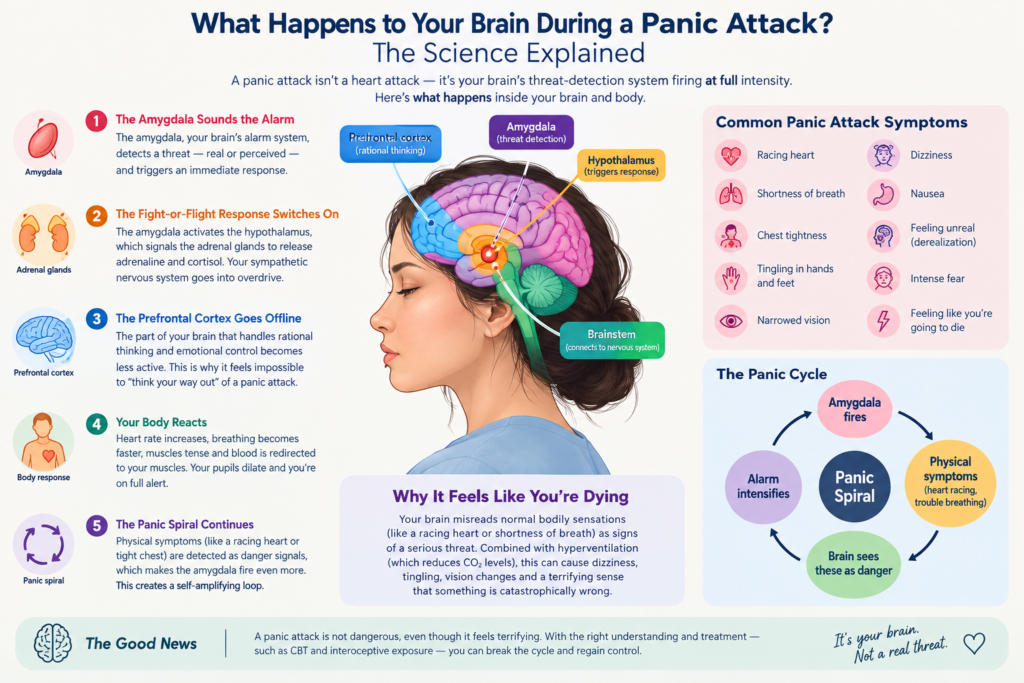
This is the same prefrontal-amygdala regulatory system that goes offline during panic attacks (Chapter 3). REM sleep is what restores it — nightly, automatically, free of charge.
For anyone living with anxiety or chronic stress, protecting REM sleep is one of the most evidence-based things available. And yet it is the stage most disproportionately lost when sleep is cut short — because REM is concentrated in the second half of the night.
The Sleep-Stress Loop — And How to Break It
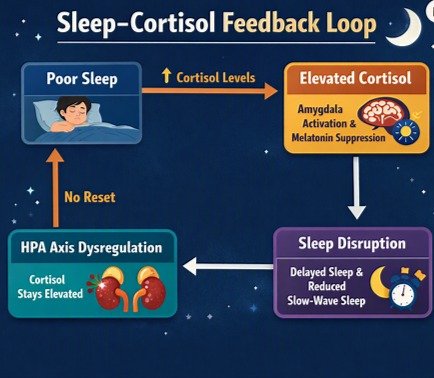
In Chapter 1, we described how chronic stress dysregulates the HPA axis and elevates cortisol. Sleep is the primary mechanism through which the HPA axis resets — and chronic poor sleep is one of the most powerful ways to undermine that reset.
A 2024 systematic review in Psychoneuroendocrinology found that sleep-deprived individuals show blunted cortisol reactivity and impaired autonomic recovery after stress — meaning a sleep-deprived person is not just more reactive to stress but less capable of recovering from it.6
The feedback loop is self-sustaining: poor sleep elevates cortisol → elevated cortisol activates the amygdala and suppresses melatonin → sleep onset is delayed and slow-wave depth is reduced → the HPA axis does not reset → cortisol remains elevated.
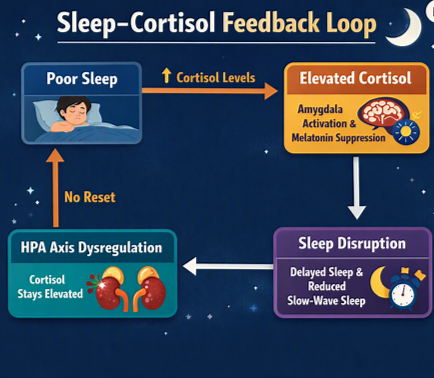
Take-Home Message: When sleep suffers, stress hormones stay high — and that same stress keeps sleep shallow. Breaking the cycle starts with restoring healthy sleep habits to help cortisol settle and the brain reset.
A 2024 meta-analysis in Sleep and Breathing confirmed across multiple databases that both short and long sleep duration are independently associated with significantly increased risk of depression and anxiety.7
Breaking this loop requires addressing both ends — the sleep itself and the stress biology driving it. The most evidence-based tool for doing so is one that most people have never heard of.
CBT-I — The Gold Standard Most People Have Never Heard Of
Cognitive Behavioural Therapy for Insomnia (CBT-I) is the most evidence-based treatment for chronic insomnia — and it remains dramatically underused.
A meta-analysis in Sleep Medicine Reviews found CBT-I superior to sleep medication for both short and long-term outcomes, with improvements maintained at follow-up in a way that pharmacological treatments do not sustain.8 The American College of Physicians recommends it as the first-line treatment ahead of medication. A 2023 paper in Sleep Medicine Clinics identified acceptance and commitment therapy (ACT) as a promising adjunct for patients who do not respond fully to standard CBT-I.9
CBT-I works through five components:
- Sleep restriction therapy (temporarily restricting time in bed to rebuild the homeostatic sleep drive)
- Stimulus control (reconditioning the bedroom as a sleep cue)
- Sleep hygiene (consistent timing, caffeine management, light control)
- Cognitive restructuring (addressing the beliefs that sustain hyperarousal)
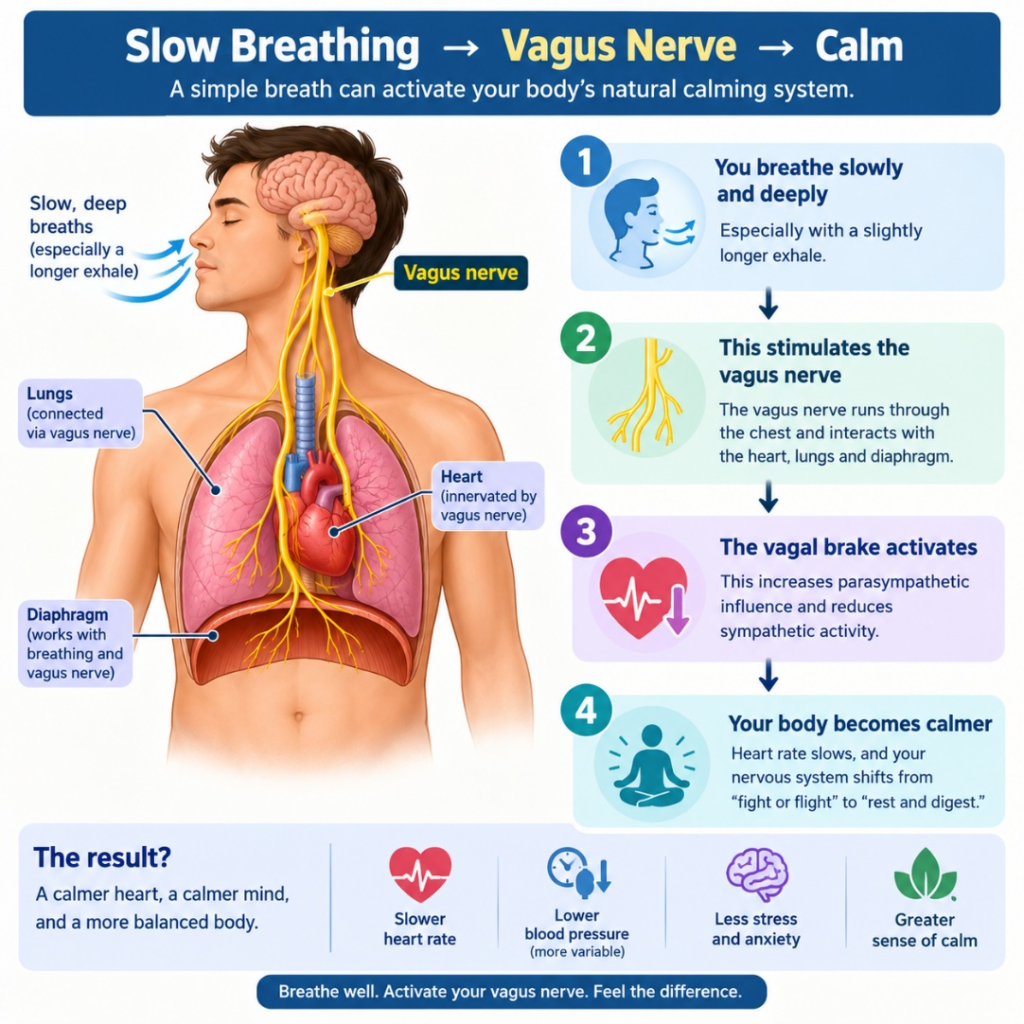
- Relaxation — including the extended exhale breathing technique from chapter 6.
Digital CBT-I programmes have demonstrated efficacy comparable to therapist-delivered treatment, significantly improving accessibility.
What You Can Do
Set a consistent wake time — even on weekends. This is the single most impactful sleep intervention. It anchors the circadian rhythm and ensures the cortisol awakening response fires at a predictable time.
Create a physiological transition into sleep — dim, warm lighting in the final hour; a cool bedroom (16–19°C); the 4-6 extended exhale breathing lying down. Core body temperature must fall to initiate sleep. These practices support that fall.
Limit caffeine after midday — with a half-life of 5–7 hours, afternoon caffeine reduces slow-wave sleep depth even when it does not appear to delay sleep onset.
Externalize pre-sleep worry — writing a to-do list for the next day 30 minutes before bed significantly accelerates sleep onset by offloading upcoming demands from working memory.10
Get morning sunlight — within the first hour of waking. A 2024 paper in PNAS identified the sleep-circadian interface as a critical window into mood and anxiety disorders, with morning light entrainment being one of the most accessible and evidence-supported interventions.11
Seek help for persistent insomnia — if sleep difficulties have persisted for more than three months or are affecting daily function, speak with a healthcare professional. CBT-I is the recommended first step.
The Bottom Line
Sleep is the night-time chapter of the invisible conversation — the hours when your brain processes the day’s emotions, your immune system conducts its most intensive repair work, your gut microbiome recalibrates, your stress hormones reset, and the glymphatic system clears the neural debris of waking life.
Every system discussed in this book depends on sleep to function properly. Cortisol regulation, gut-brain communication, neuroinflammation, emotional memory processing, amygdala reactivity — all of it is either maintained or undermined by what happens in those 7–9 hours of darkness.
Sleep is not a passive retreat from the world. It is the most active, the most complex, and the most consequential part of the invisible conversation.
Treat it accordingly.
The Invisible Conversation — A Final Word
This is the last chapter of the series. Over eleven posts, we have traced a single thread through the biology of what it means to be a human being living under pressure in the modern world.
We began with stress — with the ancient alarm system designed for a world of predators that now runs continuously in response to emails, deadlines, and the ambient noise of modern life. We visited the second brain in the gut, with its 100 million neurons quietly reporting to the brain above. We watched the amygdala hijack rational thought during a panic attack. We traced inflammatory molecules from the bloodstream into the brain. We looked honestly at burnout, at the science of breath, at the surprising evidence for magnesium, at what exercise actually does to the depressed brain, at the profound biological cost of loneliness, at the genuine — if overstated — promise of cold water. Finally, we arrive at sleep: the biological foundation on which every other system in this series depends.
The invisible conversation has many voices. Cortisol. Cytokines. Serotonin. The vagus nerve. The microbiome. Noradrenaline. The glymphatic system. BDNF. Oxytocin. None of them speaks in a language you can hear consciously. However, all of them are speaking, all the time shaping your mood, your memory, your immunity, your ability to regulate emotion, your capacity for connection, your resilience under pressure.
That is what this series has tried to make audible.
Knowledge becomes powerful when it deepens our connection with ourselves. Understanding how the body works — how breath calms the mind, how sleep restores balance, how loneliness reflects biology rather than weakness, and how the gut and brain constantly communicate — transforms the way we relate to our own physiology.
This perspective shifts the question from “What’s wrong with me?” to “What is my body trying to do?” That shift, supported by both clinical experience and research, is often where genuine healing begins.
Your body and your mind are not working against each other. They never were. They are the same system — beautifully, intricately, sometimes frustratingly interconnected — doing the best they can with the signals they receive.
The task, as it has always been, is learning to work with them.
Thank you for reading.
Shilpa Khirbat TheHealthExplainer.com
If you are experiencing persistent sleep difficulties, please speak with a qualified healthcare professional. CBT-I is available through therapists, your primary care physician, and validated digital platforms.
Subscribe My YouTube Channel | Sleep And Mental Health
References
- Dagum P, Elbert DL, Giovangrandi L, Singh T, Venkatesh VV, Corbellini A, et al. The glymphatic system clears amyloid beta and tau from brain to plasma in humans. Nature Communications. 2026;17:68374.
- Ding F, O’Donnell J, Xu Q, Kang H, Goldman N, Nedergaard M. Norepinephrine-mediated slow vasomotion drives glymphatic clearance during sleep. Cell. 2025;188(2):1–16.
- Xu Y, Huang W, et al. Glymphatic system in sleep: a nexus of waste clearance, brain homeostasis, and disease intervention. Molecular Psychiatry. 2026. doi:10.1038/s41380-026-03750-w.
- Riemann D, Nissen C, Spiegelhalder K, et al. Chronic insomnia, REM sleep instability and emotional dysregulation: a pathway to anxiety and depression? Journal of Sleep Research. 2025;34(2):e14252.
- Halonen R, Kuula L, Antila M, Pesonen AK. REM sleep preserves affective response to social stress — experimental study. eNeuro. 2024;11(6):ENEURO.0453-23.2024.
- Messa RM, Benfica MA, Ribeiro LFP, Williams CM, Davidson SRE, Alves ES. The effect of total sleep deprivation on autonomic nervous system and cortisol responses to acute stressors in healthy individuals: a systematic review. Psychoneuroendocrinology. 2024;168:107114.
- Zhang J, He M, Wang X, et al. Association of sleep duration and risk of mental disorder: a systematic review and meta-analysis. Sleep and Breathing. 2024;28:261–80.
- van der Zweerde T, Bisdounis L, Kyle SD, Lancee J, van Straten A. Cognitive behavioural therapy for insomnia: a meta-analysis of long-term effects in controlled studies. Sleep Medicine Reviews. 2019;48:101208.
- Saldaña KS, Jarnecke AM, Flanagan JC. Acceptance and commitment therapy as an adjunct or alternative treatment to cognitive behavioural therapy for insomnia. Sleep Medicine Clinics. 2023;18(1):103–12.
- Scullin MK, Krueger ML, Ballard HK, Pruett N, Bliwise DL. The effects of bedtime writing on difficulty falling asleep: a polysomnographic study comparing to-do lists and completed activity lists. Experimental Brain Research. 2018;236(6):1715–22.
- Meyer N, Lok R, Schmidt C, Kyle SD, McClung CA, Cajochen C, et al. The sleep-circadian interface: a window into mental disorders. Proceedings of the National Academy of Sciences. 2024;121:e2214756121.
sleep and mental health,sleep and mental health, sleep and mental health, sleep and mental health, sleep and mental health, sleep and mental health, sleep and mental health, sleep and mental health, sleep and mental health, sleep and mental health, sleep and mental health,sleep and mental health, sleep and mental health, sleep and mental health, sleep and mental health, sleep and mental health, sleep and mental health, sleep and mental health, sleep and mental health, sleep and mental health, sleep and mental health, sleep and mental health