Sleep Anywhere | Wake Up Human
The science of sleep on the road — why the first night is always harder, what it does to your driving, and what actually helps
By Shilpa Khirbat | B.Sc (Hons.) Biotechnology | M.Sc (Hons.) Human Genetics | Medical Writer
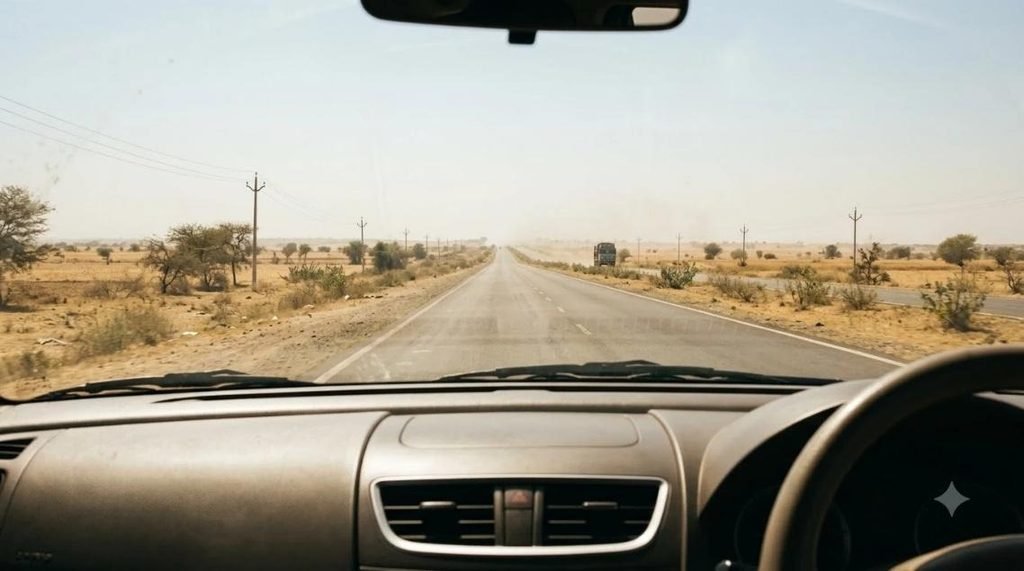
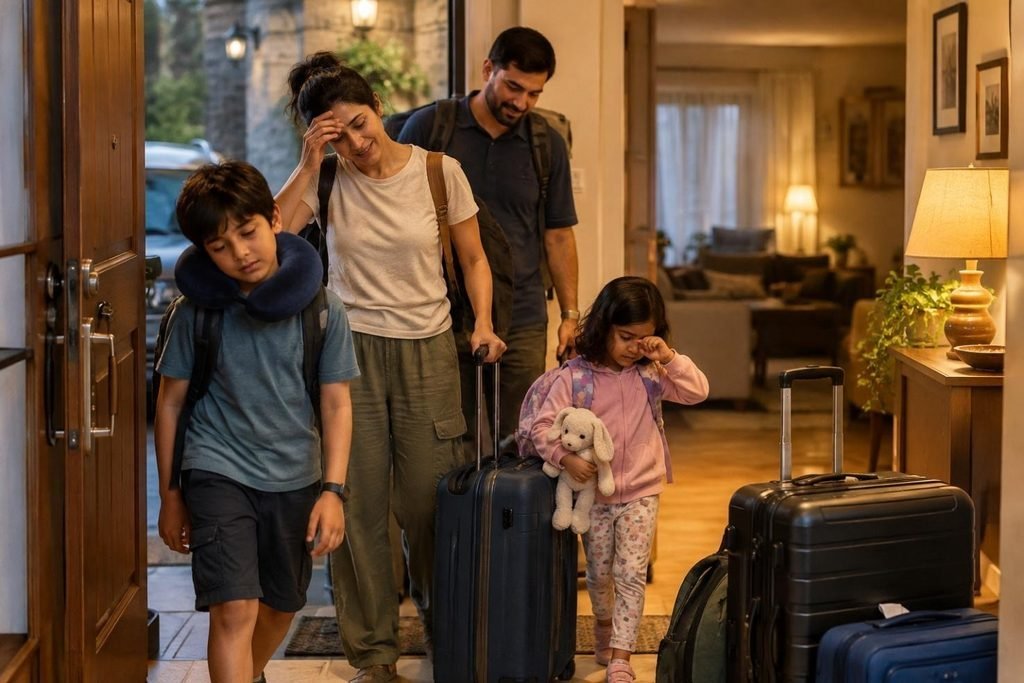
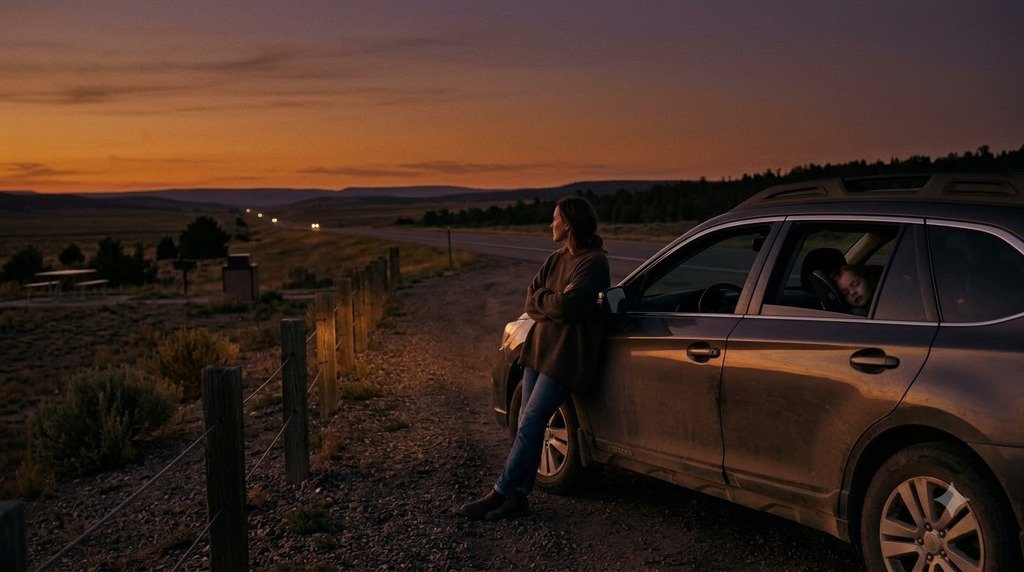
There is a particular kind of exhaustion that belongs only to the first night of a road trip. You have been driving since 5am. You covered 600 kilometers. You got the children fed, bathed, and into bed and then you lie there — in a hotel room in Jaisalmer or a tent in Himachal — listening to a ceiling fan you do not recognize, a dog somewhere in the distance, the specific quality of silence that belongs to a place that is not home. And your brain simply will not switch off.
This is not anxiety. It is not caffeine. It is biology, and it has a name.
The First Night Effect

In 2016, researchers at Brown University used full brain recordings during sleep and found something remarkable. On the first night in an unfamiliar environment, the two hemispheres of the brain do not sleep equally. The left hemisphere, dominant in most adults maintains a lighter, more vigilant state while the right hemisphere sleeps more deeply. One half of your brain stays on watch.1
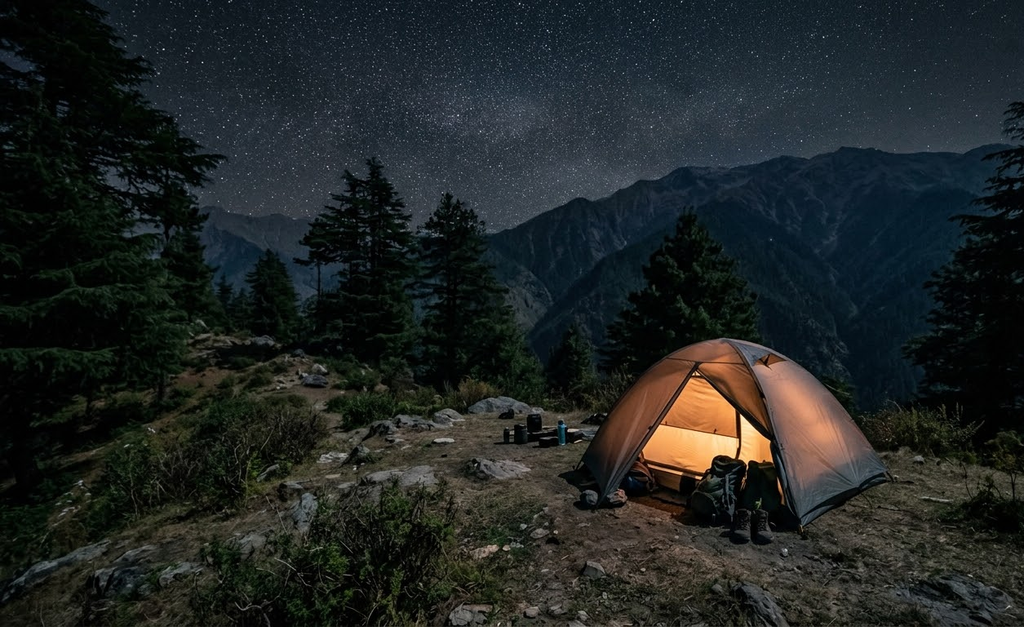
This is not a malfunction. It is an evolved protective mechanism. In the ancestral environment, sleeping somewhere unfamiliar was a genuine threat. The brain’s response was to assign one hemisphere to sentinel duty monitoring for unexpected sounds, movement, changes in the environment. In a tent in Uttarakhand, surrounded by wind in the trees and the sounds of the forest at night, this mechanism fires exactly as it was designed to. It just does not serve you particularly well at 6am when you need to pack up camp and get back on the road.
The effect is strongest on the first night. By the second night, in the same location, it diminishes significantly. By the third night, most people sleep comparably to home. If you have ever noticed that the second night somewhere is always better, you are right. The research confirms it.
Two Systems, Both Disrupted
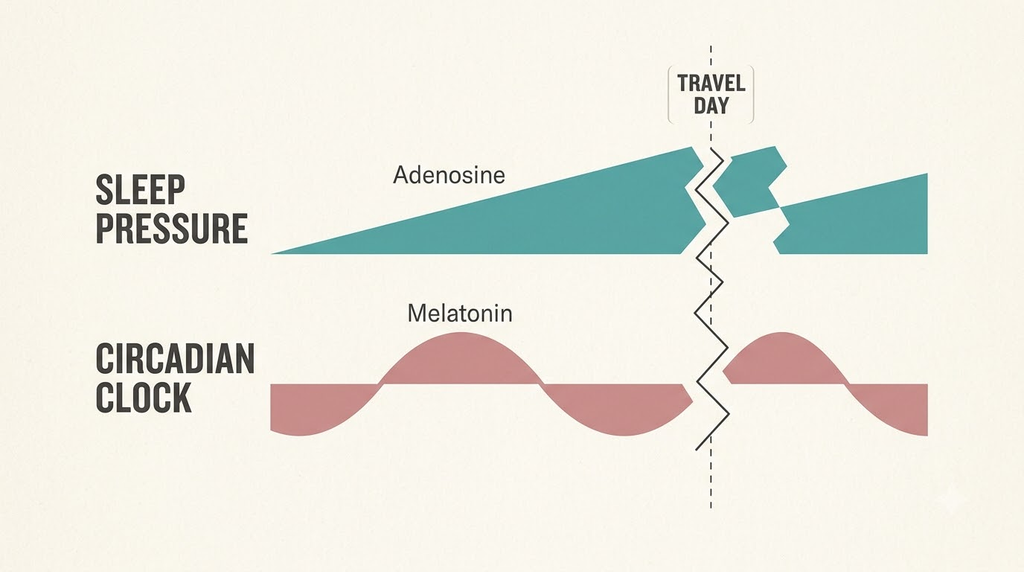
Sleep is governed by two independent biological systems working together.
The first is sleep pressure. Throughout every waking hour, a molecule called adenosine accumulates in the brain as a byproduct of neural activity. The longer you have been awake, the higher your adenosine levels, the stronger your drive to sleep. After a 10-hour drive day, this pressure is very high. In principle, you should fall asleep the moment you lie down.
The second system is your circadian clock, the biological timer in the hypothalamus that runs on a roughly 24-hour cycle, driven primarily by light. It releases cortisol in the morning to promote alertness, and melatonin in the evening to signal that sleep is approaching. When you arrive somewhere at an unusual hour, eat at a different time, or are exposed to unfamiliar light conditions, this clock falls out of alignment with your actual behaviour.2
On a long road trip, both systems are disrupted simultaneously. Sleep pressure is high because you are exhausted, but the circadian clock may not be ready to release melatonin at the time you actually stop. The result is that familiar sensation of being completely exhausted and completely unable to sleep particularly on night, one of any new location.
What the Children Are Experiencing
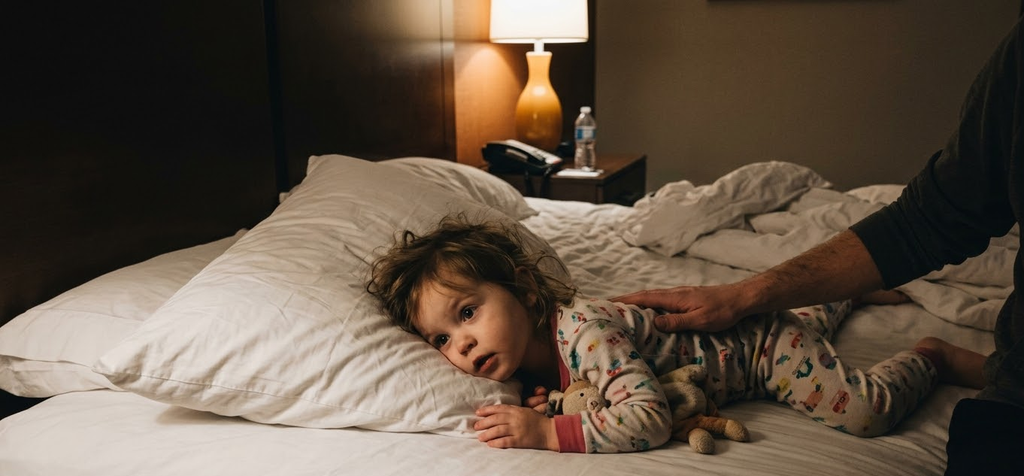
A toddler’s circadian rhythm is still maturing. Melatonin release is more variable, sleep is lighter and more active, and young children are highly sensitive to environmental cues sound, temperature, smell, and the absence of familiar objects. A three-year-old who senses that everything around her is different may simply not register this as sleep time, regardless of how tired she is.3
Older children adapt to their circadian rhythm faster than adults in some respects, but they are still more vulnerable to the first-night alertness effect particularly after a day of high stimulation. A road trip day is, neurologically speaking, a very stimulating day.
The practical implication is to not expect children to go down quickly at night one at any new location. Build an extra 30 to 45 minutes into bedtime on the first night. Keep whatever pre-sleep routine you use at home, even in a simplified form. Treat the first night’s fragmented sleep as expected biology rather than a problem to solve.
What Actually Helps

The research on sleep in unfamiliar environments points consistently to the same set of interventions.
Maintain your pre-sleep routine. The brain uses the sequence of behaviors before bed, not just the physical environment, to begin the melatonin transition. A warm wash, dim lights, quiet time: doing the same sequence on the road signals sleep onset more reliably than simply lying down in a dark room.4
Manage light in the 90 minutes before bed. In a hotel room, this means switching off overhead lights, avoiding screens, pulling the curtains fully closed. On a campsite, a campfire is genuinely helpful — firelight sits in the amber and red spectrum and does not suppress melatonin the way the blue-white light from a phone screen does.5
Control the temperature as much as you can. Research consistently identifies 18 to 21°C as the range that supports deeper sleep in most adults.6 In an over-cooled hotel room, layering works faster than adjusting the thermostat. In a tent in the hills, layering for the night-time temperature drop is essential, children lose body heat faster than adults and will wake if they are cold even when they cannot articulate why.
Pack something familiar. This matters more for children than adults, but it matters for both. A familiar pillow, a child’s blanket from home, and a small soft toy, these are not sentimental extras. They are olfactory and tactile anchors that reduce the novelty signal the brain is processing as it tries to fall asleep. Your toddler’s familiar blanket in an unfamiliar hotel room in Jodhpur is doing real physiological work.
Accept the first night for what it is. The most evidence-based piece of advice here is also the simplest. Night one will be lighter and less restorative than usual. Plan the first day after arrival to be lower in demand if possible. Do not schedule 600 kilometres on the day after your first night at a new campsite.
The Cumulative Cost
Here is something most road trip guides do not mention.
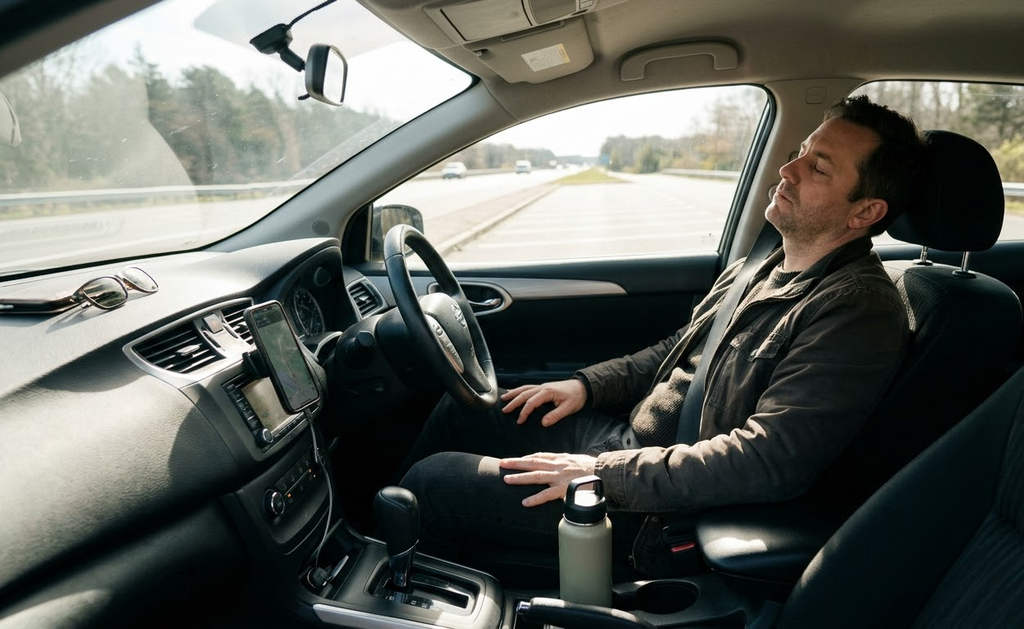
Even mild sleep restriction losing 60 to 90 minutes per night compared to your usual baseline has cumulative cognitive effects that compound over days. Research has shown that people sleeping six hours a night develop cognitive deficits equivalent to total sleep deprivation after 10 days, and critically they do not perceive themselves as significantly impaired. Their subjective sense of tiredness stabilizes while their actual performance continues to decline.7
A 10-day Rajasthan circuit is exactly the length at which these matters. If every night involves some first-night disruption, or environmental interference, or children who take longer to settle, a sleep debt builds quietly across the trip. By days seven, eight and nine, the driver’s reaction time and decision-making are genuinely affected — while they feel only normally tired.
This is not a reason to not take the trip. It is a reason to protect sleep as a non-negotiable across a long trip — to treat a genuine afternoon rest as recovery, not indulgence, and to resist the temptation to drive further on day nine to make up time lost on day two.
Your brain needs sleep to keep you safe on the road. That is not a metaphor. It is the biology of the journey.
References
1. Tamaki M, Bang JW, Watanabe T, Sasaki Y. Night watch in one brain hemisphere during sleep associated with the first-night effect in humans. Current Biology. 2016;26(9):1190–1194.
2. Blume C, Garbazza C, Spitschan M. Effects of light on human circadian rhythms, sleep and mood. Somnologie. 2019;23(3):147–156.
3. Mindell JA, Williamson AA. Benefits of a bedtime routine in young children: sleep, development, and beyond. Sleep Medicine Reviews. 2018;40:93–108.
4. Mindell JA, Williamson AA. Benefits of a bedtime routine in young children: sleep, development, and beyond. Sleep Medicine Reviews. 2018;40:93–108.
5. Blume C, Garbazza C, Spitschan M. Effects of light on human circadian rhythms, sleep and mood. Somnologie. 2019;23(3):147–156.
6. Harding EC, Franks NP, Wisden W. The temperature dependence of sleep. Frontiers in Neuroscience. 2019;13:336.
7. Belenky G, Wesensten NJ, Thorne DR, Thomas ML, Sing HC, Redmond DP, et al. Patterns of performance degradation and restoration during sleep restriction and subsequent recovery: a sleep dose-response study. Journal of Sleep Research. 2003;12(1):1–12.
My first book, The Invisible Conversation: How Your Brain, Gut and Body Talk to Each Other, is available now on Amazon in Kindle and paperback — eleven chapters of evidence-based mind-body science written for real people, not medical professionals. And if you travel with family in India, stay tuned. My next book, Go Far, Stay Well: The Science of Staying Healthy When You Travel in India, is coming soon — and this series is just a glimpse of what is inside. Follow along to be the first to know when it launches.
— Shilpa Khirbat | www.thehealthexplainer.com
Sleep Anywhere, Wake Up Human
Sleep Anywhere | Wake Up Human
Sleep Anywhere | Wake Up Human, Sleep Anywhere | Wake Up Human, Sleep Anywhere | Wake Up Human, Sleep Anywhere | Wake Up Human, Sleep Anywhere | Wake Up Human, Sleep Anywhere | Wake Up Human, Sleep Anywhere | Wake Up Human, Sleep Anywhere | Wake Up Human, Sleep Anywhere | Wake Up Human, Sleep Anywhere | Wake Up Human, Sleep Anywhere | Wake Up Human, Sleep Anywhere | Wake Up Human, Sleep Anywhere | Wake Up Human, Sleep Anywhere | Wake Up Human, Sleep Anywhere | Wake Up Human, Sleep Anywhere | Wake Up Human