Moving While Still
What eight hours in a car seat does to your spine, your circulation, and your muscles — and why the roadside stop is not a luxury
By Shilpa Khirbat | B.Sc (Hons.) Biotechnology | M.Sc (Hons.) Human Genetics | Medical Writer
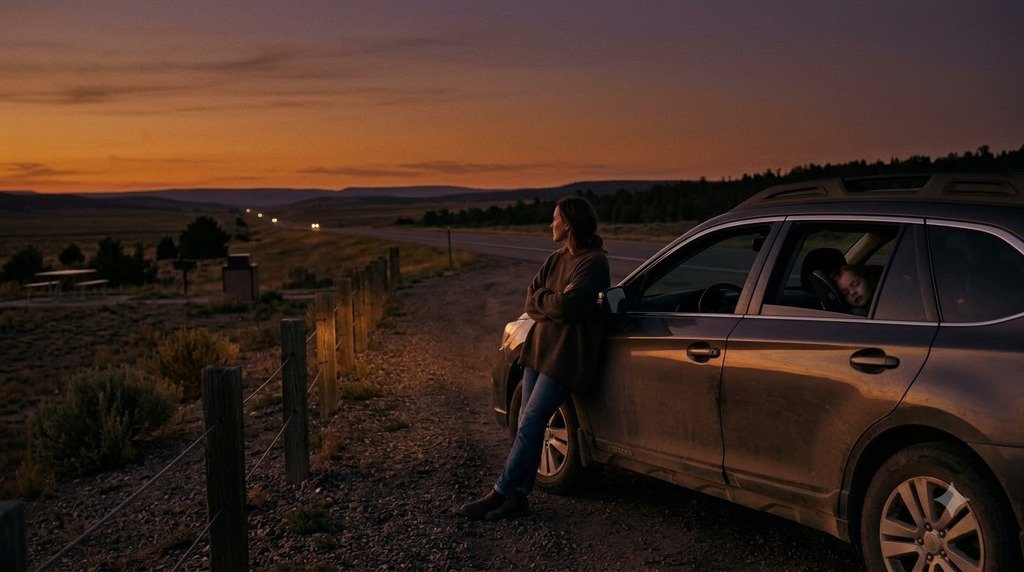
By the time you reach Jaisalmer after two days on the road, something has shifted not in the landscape, but in your body. Your lower back has a dull, persistent ache that was not there when you left Chandigarh. Your hips feel locked. Your calves are tight and when you finally step out of the car at the fort entrance and try to walk normally, your legs need a moment to remember how.
This is not tiredness or rather, it is not only tiredness. It is what eight hours of sustained sitting does to a body that was not designed to sit for eight hours.
What Happens Inside the Spine
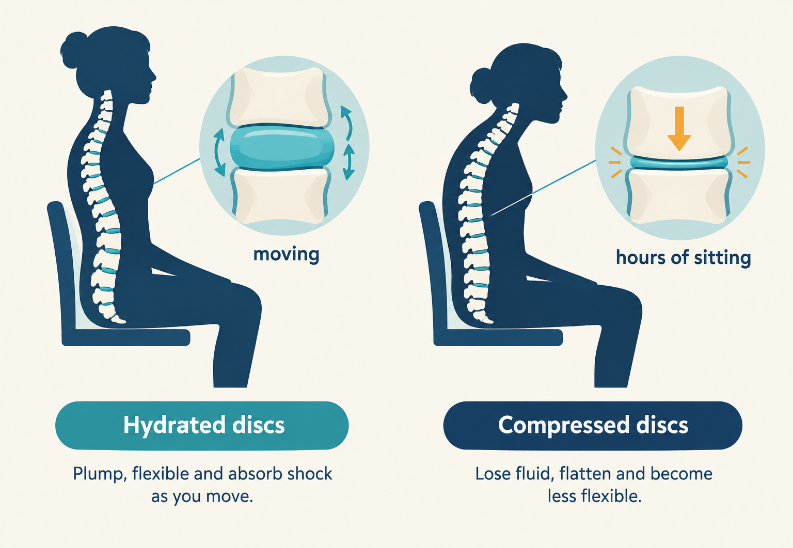
The cushions between your vertebrae, the soft, gel-like discs that absorb shock and keep the spine flexible have no direct blood supply. The only way they receive nutrients and get rid of waste is through movement: when you move, they compress and decompress, drawing in fresh fluid and pushing out the old. Sit still for long enough, and that exchange stops.1
Moving While Still
When you drive for hours without a break, these discs are under constant, unrelieved pressure. Fluid slowly gets squeezed out, the discs flatten very slightly, and the surrounding structures the muscles, joints, and connective tissue along the spine take on load they were not meant to carry alone. This is not dangerous in one sitting, but it is cumulative. It is the direct reason your back starts aching around hour four.
There is another piece to this. The muscles that hold your spine upright, the ones running along your lower back begin to tire after 60 to 90 minutes of continuous driving. Once they are fatigued, they essentially hand off the job to the ligaments and joints, which are not designed to do it for long.2
The car seat makes this worse, not better. Most seats push the tailbone slightly under, which flattens the natural curve of the lower back and puts uneven pressure on the discs. A lumbar support cushion helps but only if positioned correctly, and only for the first couple of hours.
What Happens to the Muscles at the Front of Your Hip
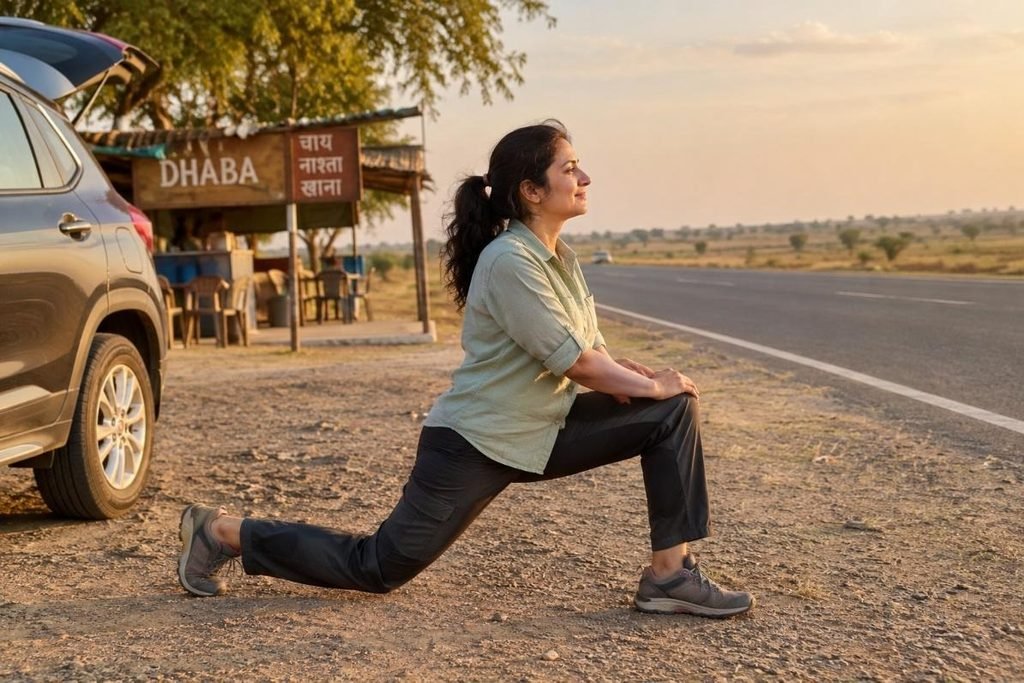
There is a deep muscle running from your lower spine to the top of your thigh, the one that lifts your leg when you walk. During a long drive, it stays in a shortened, contracted position for hours. When you finally stand up, it does not simply let go. A muscle that has been held short for that long pulls the base of your spine forward, creating the tight, heavy feeling in your lower back and hips that every long-distance driver recognises.3
This is why a simple lunge stretches at a rest stop one leg forward, the other knee almost touching the ground, held for 30 seconds each side gives such fast, obvious relief. You are not just loosening a stiff muscle; you are releasing a structure that has been pulling on your spine for hours. The relief is quick because the mechanism is direct.
The Circulation Problem
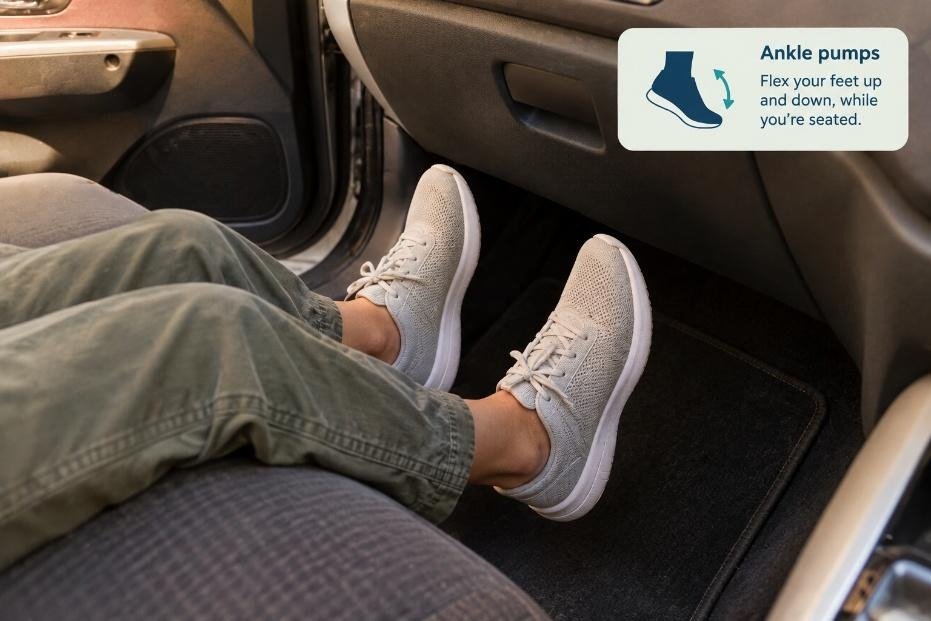
Your calf muscles act like a pump. Every time they contract, when you walk, when you climb stairs, they squeeze the veins in your lower legs and push blood back up toward the heart. When your legs are still for hours, this pump sits idle. Blood pools in the lower legs, the veins stretch slightly, and the circulation slows. In people who are dehydrated, travelling in heat, or who have certain risk factors, this slow-moving blood can, in rare cases, form a clot in a deep vein most commonly in the calf.4
Most people associate this risk with long flights. The mechanism is identical in a car. The position is the same, the duration of a road trip can be similar, and the heat and dehydration of Indian summer travel makes the blood thicker, which amplifies the risk. The guidance applies equally to any journey over four hours, by any mode of transport.
The fix is simple: pump your ankles. Flex and point at your feet repeatedly, even while seated, every 30 to 45 minutes. It takes ten seconds and reactivates the calf pump without needing to stop. When you do stop, five minutes of walking is enough to clear whatever has pooled in the legs during that segment.
The Children in the Back Seat
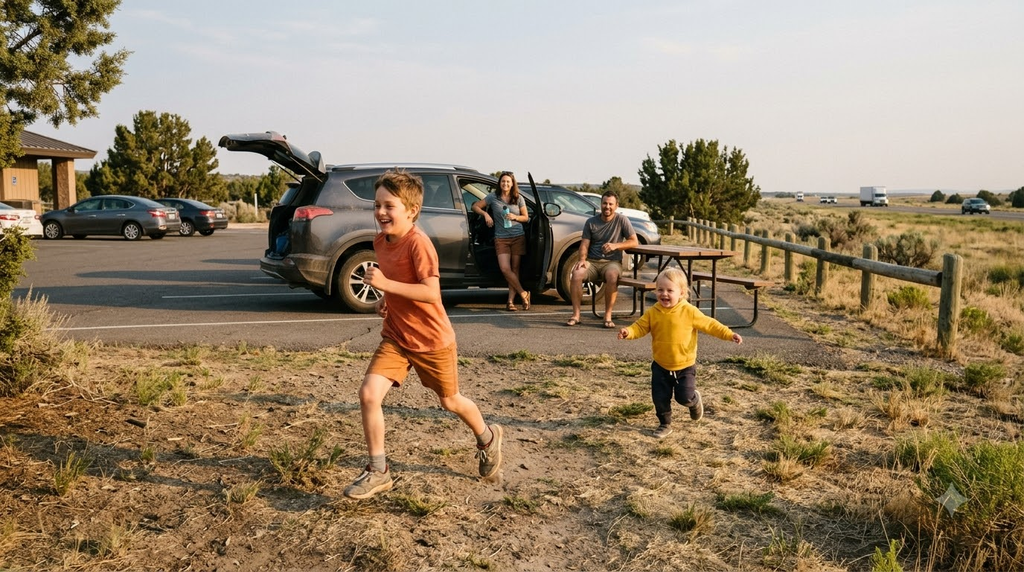
Children cope better with some aspects of long drives their spinal discs are more flexible and their bodies recover faster. However, their core muscles tire sooner than an adult’s, and standard car seat positions particularly rear-facing seats for toddlers do not support the natural curve of a developing spine well.5
The restlessness that arrives in children around hour three is not impatience. It is the body sending a physical signal that the position has become uncomfortable. The books and drawing they do in the car also help more than you might think reaching, leaning forward, shifting around these small movements break the sustained stillness just enough to give the body some relief.
The two-hour guideline for infant car seats that babies and young toddlers should not be kept in a rear-facing seat for more than two hours at a stretch comes directly from this. The reclined position limits how freely a small chest can expand and slows circulation in the lower body. It is not an arbitrary rule. It is a physiological limit.
What the Research Says about Breaks
A review published in 2023 looked at what happens when you interrupt long periods of sitting with very short bursts of movement two to five minutes of light activity every 30 to 60 minutes. The findings were consistent: even those brief interruptions meaningfully reduced the physical toll of sustained sitting on the heart, metabolism, and muscles. Notably, two minutes of walking produced more benefit than you would expect from just two minutes.6
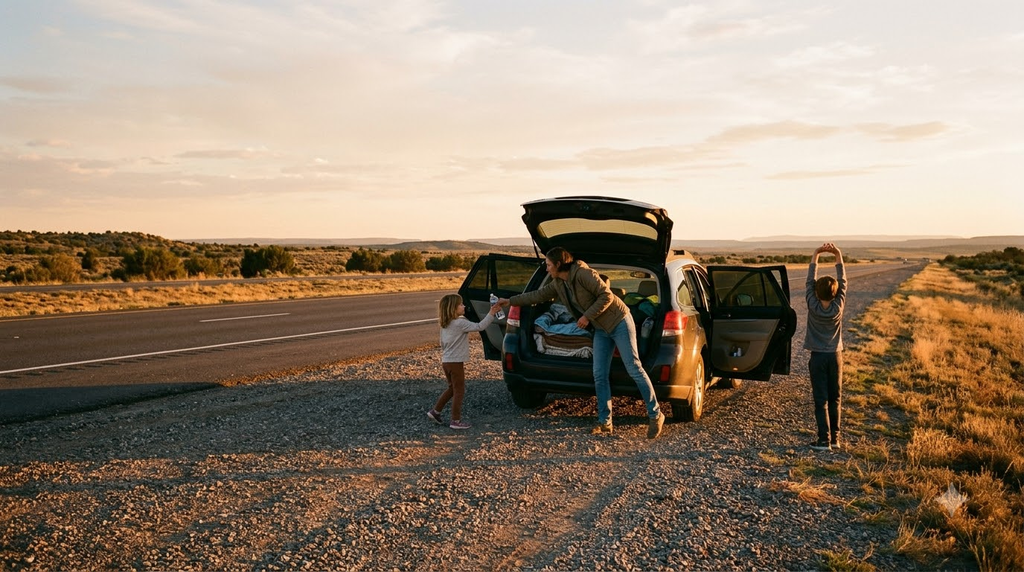
Applied to a road trip, this means the dhaba stop is not a delay. It is maintenance. A 15-minute break every two to three hours enough to walk around, stretch, and drink water is not indulgence. It is what keeps the remaining hours safer and the arrival less degraded.
On the Rajasthan circuit, the rhythm of the route tends to provide these naturally. The challenge is the stretches where the road opens up, and the temptation is to push through. That is exactly when the break matters the most, because the best road conditions are also the conditions under which you sit still the longest.
What to Do at Every Stop
The sequence does not have to be long. Five to ten minutes, used deliberately, is enough.
Walk first. Do not sit down at the dhaba the moment you step out. Walk to it. Even three to four minutes of walking wakes up the calf pump, starts restoring the back muscles, and begins rehydrating the spinal discs.
Stretch the front of your hip. A low lunge on each side, held for 20 to 30 seconds, releases the muscle that has been pulling on your lower back since the last stop. This is the single most useful stretch for road trip back pain, and it takes under two minutes.
Move the children. Let them run or walk freely for a few minutes. Their restlessness clears quickly with free movement which is also why they arrive at stops with sudden energy. The fatigue was positional, not neurological, and movement resolves it fast.
Drink water before getting back on the road, not when you start feeling thirsty. Use every stop as an opportunity to hydrate. This helps maintain good blood flow for the next stretch, lowers the risk of clot formation, and keeps the driver more alert and focused throughout the journey.
Movement is what the body runs on. Not the distance-covering movement of the wheels that belongs to the car. The movement the body needs is its own: the small, regular, fluid-cycling movement that sustained sitting prevents. Understanding this does not slow the journey. It changes what you do with the time you stop.
References
1. Urban JPG, Roberts S. Degeneration of the intervertebral disc. Arthritis Research & Therapy. 2003;5(3):120–130.
2. Magnusson ML, Pope MH, Wilder DG, Areskoug B. Are occupational drivers at an increased risk for developing musculoskeletal disorders? Spine. 1996;21(6):710–717.
3. Penney T, Ploughman M, Austin MW, Behm DG, Byrne JM. Determining the activation of gluteus medius and the validity of the single leg stance test in chronic, nonspecific low back pain. Archives of Physical Medicine and Rehabilitation. 2014;95(10):1969–1976.
4. World Health Organization. WHO Research into Global Hazards of Travel (WRIGHT) Project: Final Report of Phase I. Geneva: WHO; 2007.
5. Avionaut. The seat and the child’s spine. Avionaut Knowledge Base. 2022.
6. Galmes-Panades AM, Borras PA, Vidal-Conti J. Exercise snacks as a strategy to interrupt sedentary behavior: a systematic review of health outcomes and feasibility. Frontiers in Public Health. 2023;11:1079608.
My first book, The Invisible Conversation: How Your Brain, Gut and Body Talk to Each Other, is available now on Amazon in Kindle and paperback — eleven chapters of evidence-based mind-body science written for real people, not medical professionals. And if you travel with family in India, stay tuned. My next book, Go Far, Stay Well: The Science of Staying Healthy When You Travel in India, is coming soon — and this series is just a glimpse of what is inside. Follow along to be the first to know when it launches.
— Shilpa Khirbat | www.thehealthexplainer.com
Moving While Still
Moving While Still, Moving While Still, Moving While Still, Moving While Still, Moving While Still, Moving While Still, Moving While Still, Moving While Still, Moving While Still, Moving While Still, Moving While Still, Moving While Still, Moving While Still, Moving While Still, Moving While Still, Moving While Still, Moving While Still, Moving While Still, Moving While Still, Moving While Still,