By Shilpa Khirbat | Medical Writer & Health Blogger This is Part 1 of the Go Far, Stay Well series at The Health Explainer. Read the full series: Part 1 | [Part 2] | [Part 3]
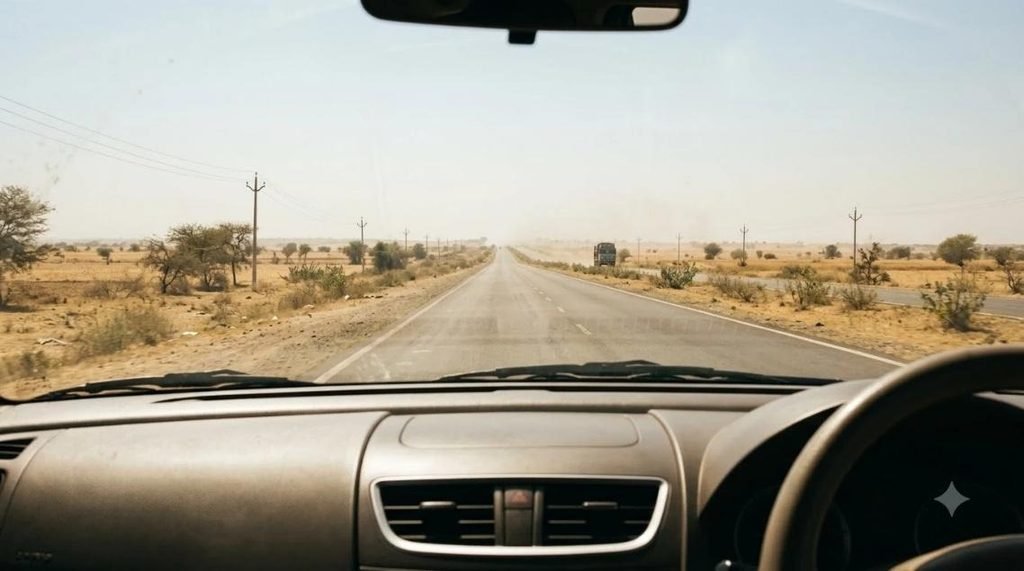
It is 2pm somewhere on the highway. You left Chandigarh before dawn. You have covered 600 kilometres. The children have been fed, squabbled, napped, and woken up demanding to know how much longer. The car has been running for nine hours. So have you.
Here is what the science says is happening inside your body right now.
Your reaction time has slowed measurably. Your ability to detect hazards at the periphery of your vision has reduced. Your blood sugar has been on a slow decline since the last stop and if the air conditioning has been running which on a Rajasthan road in April it certainly has, you are mildly dehydrated in a way that is already affecting your driving, even though you cannot feel it.
These biological changes do not announce themselves dramatically. That is precisely what makes them worth understanding.
What Is Happening in the Driver’s Brain

After just two hours of continuous highway driving, your brain’s ability to detect hazards drops measurably. This phenomenon is known as vigilance decrement: the gradual reduction in the brain’s ability to maintain peak alertness during a monotonous, repetitive task.1
Highway driving is paradoxically one of the most conducive environments for this decline. The scenery changes, but the demands on your attention remain largely the same. Your posture barely changes, and the road becomes increasingly predictable.
Under these conditions, the brain’s arousal systems begin to dial down. Microsleeps, brief episodes of unconscious inattention lasting two to fifteen seconds, begin to occur without the driver’s awareness.2
The driver navigating twelve lanes of mixed traffic at 2pm after nine hours on the road is doing so with a brain that has been continuously vigilant since 5am. The research is not ambiguous about what that means for safety.3
A genuine 15-minute break away from the wheel every two hours, not a petrol stop where you check your phone, but actual rest away from the driver’s seat, resets the vigilance baseline more effectively than any amount of coffee.
Dehydration and the Driving Error Rate
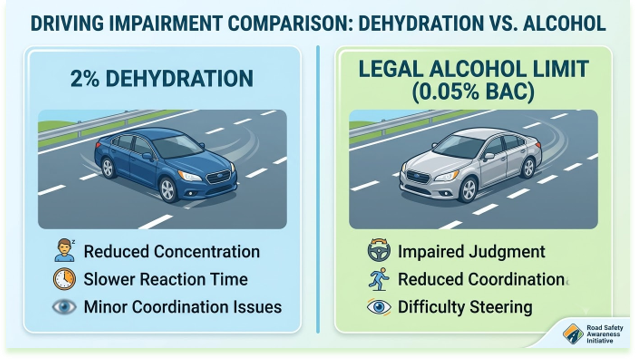
Here is one of the most surprising findings in driving research: losing just 1-2% of body water, often without noticeable thirst, can increase driving errors to a level comparable to the legal alcohol limit.4
Lane drifting, late braking and variable speed control are all measurably worse under mild dehydration. In an air-conditioned car in Indian summer heat, that dehydration builds silently across the driving day. Children dehydrate faster than adults because of their proportionally larger body surface area; they lose water through the skin more rapidly in hot environments.
Aim to drink 250-300 ml of water each hour rather than waiting until you feel thirsty. By the time, thirst registers meaningfully, your reaction time has already dropped.
What Prolonged Sitting Does to Small Bodies
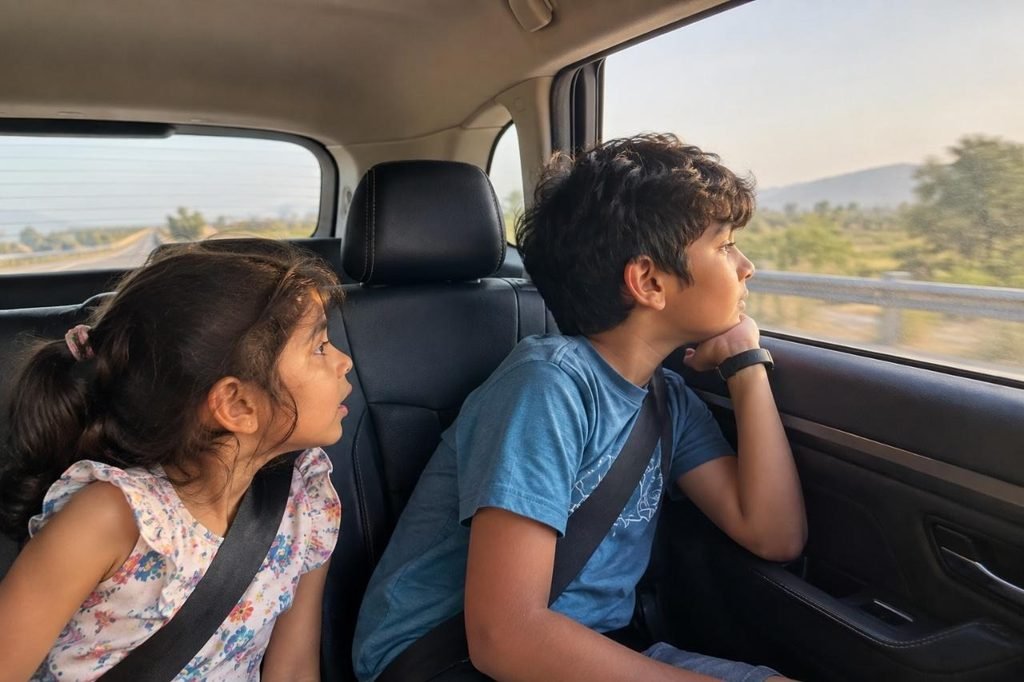
Children are not simply bored in the back seat. Their bodies are under specific physiological stress.
A study examining the effects of three hours of uninterrupted sitting on children found measurable reductions in cerebral blood flow, the blood supply that supports brain activity and mood regulation.5 Keeping children mentally engaged with books, puzzles, drawing, or a Rubik’s Cube is not just about preventing boredom. Active cognitive tasks maintain prefrontal engagement and reduce the restlessness that comes from understimulated minds in sedentary bodies. Neurologically speaking, a child absorbed in a book or puzzle is likely in a better state than one passively watching a screen and is often considerably more settled as a result.
Prolonged sitting also slows gut motility in children the digestive contractions that move food through the system. This contributes to the abdominal discomfort, reduced appetite, and irritability that many children experience on long drives. The squirming and unexplained crankiness in the back seat may be a physiological signal rather than simply behaviour to distract away. Ten minutes of genuine movement at a stop restores that blood flow. A petrol station visit, where they stay in the car does not.
Stop every two hours. Let them run.
What You Can Do
Drive in two-hour blocks. Set a timer. Take a real break, walk away from the car, sit somewhere that is not the driver’s seat, let your brain disengage from the road.
Hydrate before you are thirsty. 250–300 ml per hour for adults, proportionate for children. Start the day well-hydrated rather than catching up en route.
Choose protein-rich, minimally processed snacks. Nuts, whole fruit, roasted chana, boiled eggs, the foods that produce slow, sustained glucose release. The blood sugar crash from highway biscuits and chips lands hardest between 1pm and 4pm, exactly when your circadian alertness is already at its daily low.
Avoid driving between 1pm and 4pm where possible. This is the intersection of post-lunch blood sugar dip and the brain’s circadian alertness trough, the highest-risk window of the driving day.
Long road trips challenge far more than our patience. They test the systems that regulate attention, hydration, digestion and energy. Understanding that biology can make travel safer and a lot more comfortable.
Next in the series: Part 2 — Your Gut Does Not Like Turbulence: the microbiome, traveller’s diarrhoea, and eating smart on Indian roads.
If this made you think differently about how your body works on the road, there is much more where this came from.
My first book, The Invisible Conversation: How Your Brain, Gut and Body Talk to Each Other, is available now on Amazon in Kindle and paperback (https://a.co/d/02y1godv ) — eleven chapters of evidence-based mind-body science written for real people, not medical professionals.
And if you travel with family in India, stay tuned. My next book, Go Far, Stay Well: The Science of Staying Healthy When You Travel in India, is coming soon — and this series is just a glimpse of what is inside.
Follow along to be the first to know when it launches.
— Shilpa Khirbat | www.thehealthexplainer.com
This post is for educational purposes and does not constitute medical advice.
References
- Adachi M, Nobukawa S, Inagaki K. Assessment of driver fatigue-related brain responses during driving under different traffic conditions. Frontiers in Applied Mathematics and Statistics. 2024. doi:10.3389/fams.2024.1426253.
- Saleem AA, Siddiqui HUR, Raza MA, et al. A systematic review of physiological signals based driver drowsiness detection systems. Cognitive Neurodynamics. 2023;17(5):1229–59.
- Ridgeway C, Iridiastadi H, Crowder T, Islam M, Soccolich S. Unravelling the complexity of irregular shiftwork, fatigue and sleep health for commercial drivers. International Journal of Environmental Research and Public Health. 2022;19:14780.
- Watson P, Whale A, Mears SA, Reyner LA, Maughan RJ. Mild hypohydration increases the frequency of driver errors during a prolonged, monotonous driving task. Physiology and Behavior. 2015;147:313–8.
- Weston ME, Crozier M, Brotto R, et al. Exercise breaks prevent attenuation in cerebrovascular function following an acute bout of uninterrupted sitting in healthy children. Experimental Physiology. 2024. PMC10988444.