gut health
By Shilpa Khirbat | Medical Writer & Health Blogger This is Part 2 of the Go Far, Stay Well series at The Health Explainer. Read the full series: [Part 1] | Part 2 | [Part 3]
My son kept getting stomach upsets on our road trips. We experienced this during our short weekend trips close to home. Every time. Until I read the science behind why it kept happening.
What I found was not a list of foods to avoid. It was a biological mechanism, a clear explanation of why the gut is the most disrupted organ during travel, and why specific food decisions make a disproportionately large difference to whether a trip stays enjoyable or becomes defined by urgent toilet stops.
Once we understood the biology, we changed our approach. The long trips that followed went well. This post explains what we learned.
Why Your Gut Struggles on the Road
Your gut microbiome, the trillions of bacteria that keep your digestion working and your immunity functioning, is one of the most environmentally sensitive systems in the body. Research shows that measurable changes in microbial composition begin within the first 48–72 hours of travel, driven by dietary change, stress, dehydration, and prolonged sitting; all of which happen simultaneously on a long road trip.1
The result is reduced microbial diversity, the breadth of different bacterial species present, and a shift in the bacterial balance that increases susceptibility to gut infections.2 Your gut, in other words, arrives at the destination already slightly compromised.
Add the stress of a long driving day — which elevates cortisol and directly alters gut motility and permeability — and you have a system that is more vulnerable to whatever it encounters at the roadside dhaba than it would be at home.
The Three-Tier Food System That Kept Us Well
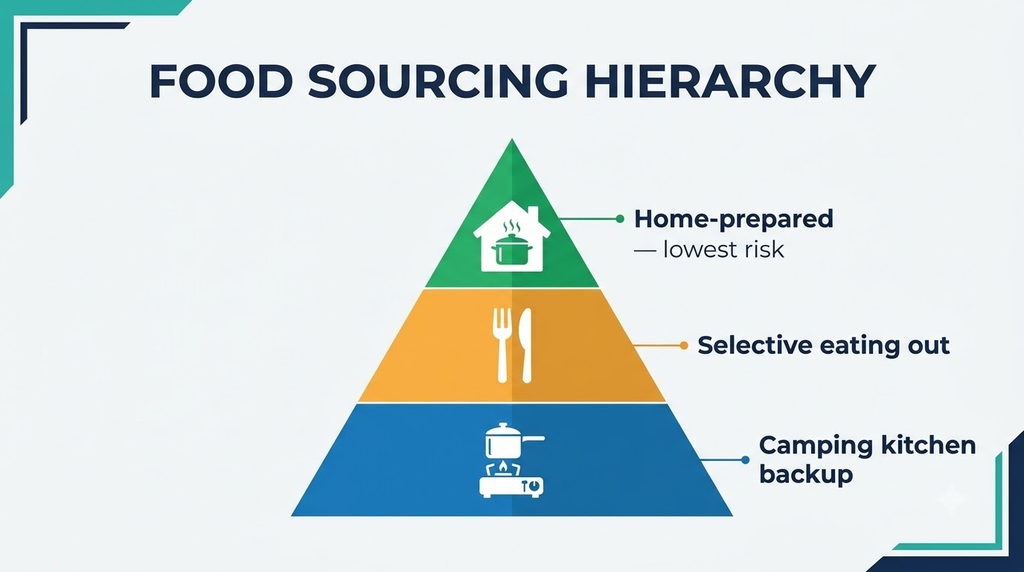
After understanding the biology, we built a simple approach to food sourcing on road trips — one that the clinical literature on traveller’s diarrhoea strongly supports.
Tier 1 — Home-prepared foods. Roasted makhana, dry fruit wheat balls, home made cerelac for the toddler. Low moisture content means bacteria cannot multiply. Balanced macronutrients — protein, fat, fibre, carbohydrates — mean stable blood sugar across the driving day. These go in the bag the night before we leave.
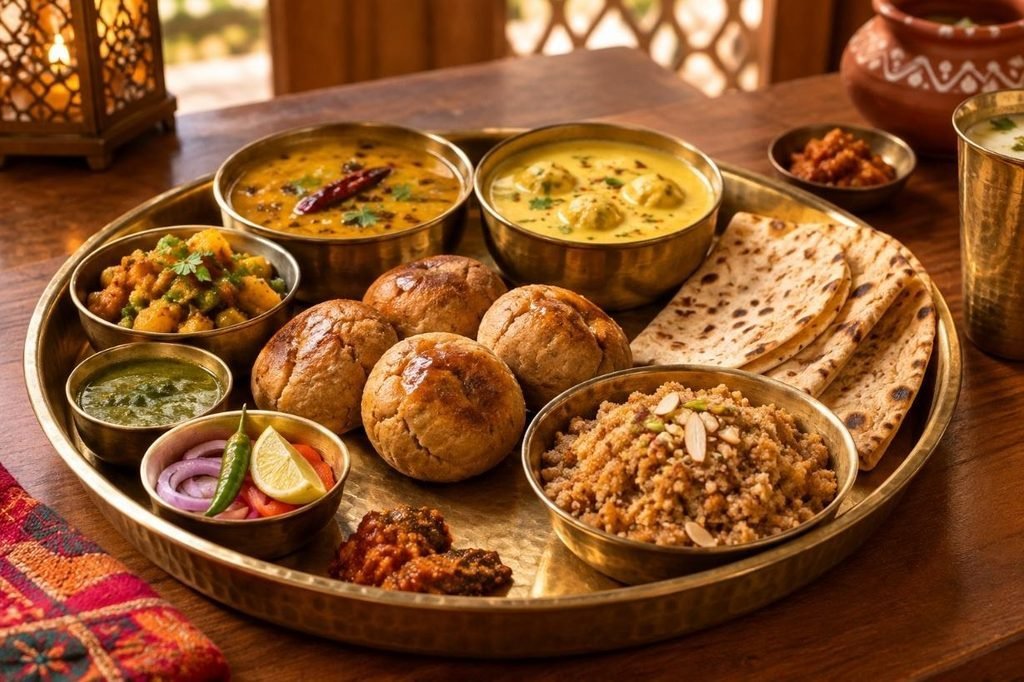
Tier 2 — Selective eating out. Traditional Rajasthani food at established restaurants, hotel breakfast buffets, reaching our booked hotel before dinner. The research on traveller’s diarrhoea in India is specific: travel style is the single most important risk factor, with food sourcing decisions — not bad luck — driving most of the difference between travellers who get sick and those who do not.3 Freshly cooked hot food at a known establishment is low risk. Pre-prepared food at ambient temperature in summer heat is not.
Tier 3 — Camping kitchen backup. When nothing outside meets the standard, we cook ourselves. Khichdi for an upset stomach — rice and lentils together produce a low-residue, easily digestible meal that reduces load on an inflamed gut. Pulao with nutri, onion, and potato as a complete one-pot meal. Bread omelette for quick protein. Everything cooked to safe temperature with clean water. The primary transmission route for traveller’s diarrhoea — contaminated food preparation — is eliminated entirely.
The One Thing Most Families Overlook
The most common gut complaint on Indian road trips is not traveller’s diarrhoea. It is constipation — and it affects children more than adults.
Prolonged sitting slows colonic transit time. Dehydration causes the colon to extract more water from its contents. Reluctance to use roadside toilet facilities means the defecation reflex is repeatedly suppressed. Repeated suppression progressively raises the threshold at which the reflex fires — making constipation increasingly likely across a multi-day trip.
The fix is straightforward: hydrate consistently, eat fibre-rich snacks, stop every two hours and let children use facilities rather than waiting, and cook khichdi at camp when the digestive system needs a reset.
What You Can Do
Pack the night before. Home-prepared, low-moisture snacks in the bag before you leave. Camping kitchen stocked with clean water, premix, and one-pot meal ingredients.
Apply the food hierarchy on the road. Home snacks first. Freshly cooked hot food at established restaurants second. Camping kitchen when in doubt.
Carry ORS sachets. Oral rehydration solution — available at any medical shop in India — is the clinical standard for managing dehydration from diarrhoea. Pack it before you need it.
Watch children closely. Young children dehydrate faster, their microbiomes are more sensitive to dietary change, and their gut motility is more easily disrupted by travel. The child who is unaccountably miserable on day two may have a gut-brain feedback loop driving the mood, not just tiredness.
Next in the series: Part 3 — The Heat Your Body Did Not Prepare For: the science of climate transitions and staying safe from Chandigarh to the Rajasthan desert.
If this made you think differently about how your body works on the road, there is much more where this came from.
My first book, The Invisible Conversation: How Your Brain, Gut and Body Talk to Each Other, is available now on Amazon in Kindle and paperback — eleven chapters of evidence-based mind-body science written for real people, not medical professionals.
And if you travel with family in India, stay tuned. My next book, Go Far, Stay Well: The Science of Staying Healthy When You Travel in India, is coming soon — and this series is just a glimpse of what is inside.
Follow along to be the first to know when it launches.
— Shilpa Khirbat | www.thehealthexplainer.com
This post is for educational purposes and does not constitute medical advice.
References
- Wang Y, Wang S, Shen M, et al. Daily sampling reveals rapid microbiota alterations during travel. npj Biofilms and Microbiomes. 2026. doi:10.1038/s41522-026-00977-x.
- Campion D, Ponzo P, Evangelista I, et al. Gut microbiota composition in travellers is associated with faecal lipocalin-2. Frontiers in Cellular and Infection Microbiology. 2024;14:1387126.
- Heusser R, Heusser I, Steffen R. Travel style is a major risk factor for diarrhoea in India: a prospective cohort study. Clinical Microbiology and Infection. 2015;21(7):676.e1–4.
- Alharbi BF, Alwahbi BM, Alharbi KS. Investigating the influence of probiotics in preventing traveler’s diarrhea: meta-analysis based systematic review. Travel Medicine and Infectious Disease. 2024;59:102703.
An explanation of the gut-brain connection in the video below
Explaination of Gut Brain Connection in video below
gut health, gut health, gut health, gut health, gut health, gut health, gut health, gut health, gut health, gut health,